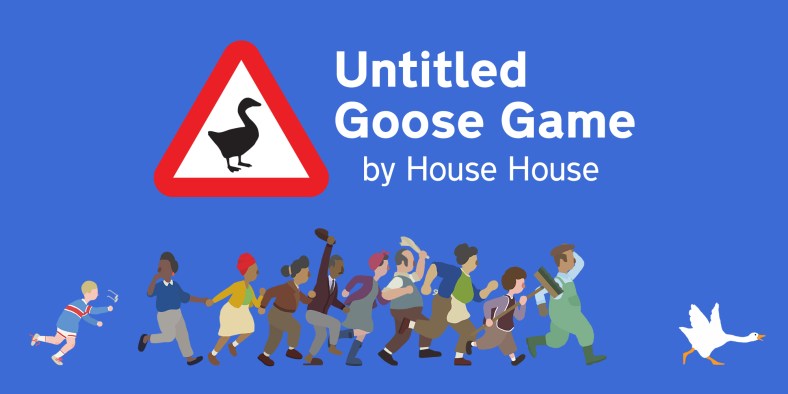
A philosophy of game design I heard nearly a decade ago is that a game should be fun or interesting, if it cant be both. Today, you see a lot of AAA studios struggle to build even one of these two important pillars. It’s in the indie scene where developers are trying new, different things, unmotivated by trying to please the largest possible audience and instead focused on delivering a unique experience that will hopefully leave a lasting impression. House House has managed to do just that with their simply-named Untitled Goose Game.
Players take control of the eponymous goose as they harass the various inhabitants of an quiet and comfortable English town. That’s your entire set-up: go be a dick to the unsuspecting townsfolk. And man, is it fun to disrupt their way of life. The game quickly opens by teaching players how to control their bird, complete with honking and flapping your wings, before dropping you off at the first level.
Here, unlike something like, say, Goat Simulator, UGG does limit players to the laws of physics, but that doesn’t mean the mayhem isn’t entertaining. On the contrary, in fact. By sneaking around and solving puzzles, your goal is to create as much chaos within the hamlet as possible. Of course, while it’s fun to just outright annoy some of the townspeople, you’re also given a “to do” list of various things you can accomplish to create frustration and bedlam. From making a young boy buy back his own toys to destroying someone’s prize-winning garden to performing for a couple of pubgoers, each area provides players a new set of challenges to overcome, culminating in the destruction of the town’s own model village.
It’s a deceptively simple game, with everything, including the art style and even the title, lulling you into a false sense of security. Some of the puzzles seem too easy, like chasing someone from point A to point B, while others can be somewhat confusing. Is the “burly man” the one in front of the pub, or the one cleaning up on the inside? Almost all of the puzzles can be solved through logical thinking, creative problem-solving, and a dash of deviousness, but some of them aren’t as innately decipherable as others. Try to avoid using a walkthrough as much as possible, though, because after you discover the answers, you’ll no doubt smack your head and exclaim, “I should’ve known that!”
There are a ton of details, hidden shortcuts, and additional challenges that add on to the game’s quick completion time. I was almost disappointed by how short the game was for its price, but with the post-game task lists, there’s more to do than just completing the main story (which should only take a couple of hours, roughly). There doesn’t seem like much to this game at first glance, but that’s part of the fun. It’s a surprising and entertaining little jaunt, a fun self-contained experience that will let you unleash your inner sadist.
I don’t have much else to say, really. It’s a neat, compact experience that’s guaranteed to get you to laugh. Personally, I loved just walking through the village and exploring the quiet, cel-shaded community. The atmosphere reminded me a lot of the film Hot Fuzz, with the snug civic-planning and carefree villagers who freak out at the slightest disruption of calm. It makes me wonder what they did with all the crusty jugglers, though?
I remember hearing about American McGee’s Alice way back when it first came out, even though I was still a child. All I really knew about it was that it was Alice in Wonderland but dark, twisted, and so edgy, Tim Burton couldn’t handle it. And although it popped up again over a decade later, in the form of its sequel, Alice: Madness Returns, it was still just a blip on my radar. But recently, I’ve heard and read some conversations reminiscing about the games, their creative art design, and their fun take on the typical Wonderland story. Curiosity plus disposable income meant I could finally dive through the looking glass and take on these games for myself.
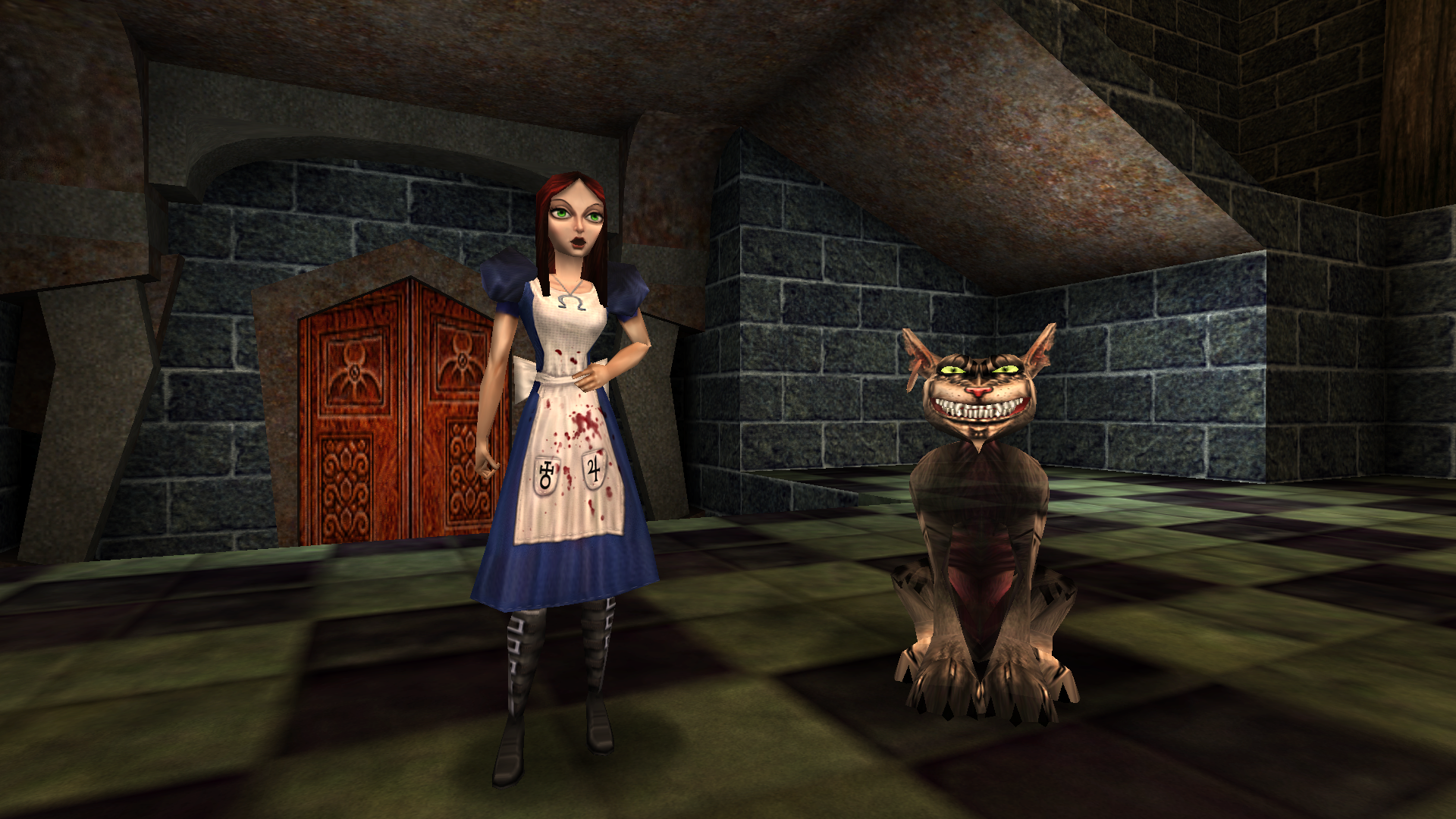
When you start the first game, Alice is a patient at a mental hospital, recovering after a fire killed her family and left her horribly burnt but alive. That went from zero to sixty quickly, from a cheery fairy tale to a deranged delve into the human psyche, but I’m for it. Wonderland has been equally decimated to reflect Alice’s state of mind, and so she has to defeat the Red Queen in order to rescue her sanity.
My first impression is: WOW, is this game difficult! I enjoy a challenge when playing a game; there needs to be a some adversity to overcome, or else the game it is too easy and not stimulating enough. I say all of this because there’s a difference making a game difficult and what you have to go through in order to beat American McGee’s Alice. First, her controls are, for lack of a better word, slippery. I played this on an Xbox 360, so my experience is different from the original PC version released in 2000, but I have to wonder if the platforming was just as difficult on a computer as on a console. Alice slides around when you so much as tilt the control stick, making it easy to just slip into a death pit. Plus, there’s a delay on the jump action! You have to remember to time each jump carefully because there’s a half-second between the button press and Alice going into the air. If there were an autosave or a quick save, this wouldn’t be terrible, but the game only autosaves at the start of each level, and you have to manually save the game each time you want to return from that point. It’s tedious, and if you’re at the end of a level, fall, and didn’t remember to save, you’ll go all the way back (I’m looking at you, Vale of Tears). I know it’s a convention of older games, but a lot of it feels like it’s there to waste time.
All of that said, I would prefer to have these issues over extremely challenging combat…but this game has both! I played on normal difficulty, and I was clenching my teeth in rage at points. Even the game’s earliest enemies can swarm and kill you in just a few hits, while they can just soak up the damage without so much as getting a scratch. Avoid using melee weapons under any circumstances, too, because your swing has no reach and has a ridiculously long recovery time, meaning enemies can get three or more hits in by the time you get one. The ranged weapons were nice, but quickly running out of willpower means you’ll be sprinting circles around enemies, stabbing their ankles with the Vorpal Blade, just enough to get a meta-substance and recover your magic so you can return to throwing playing cards or jacks. Most of the weapons are stylized as “toys,” so that justifies writing such a ridiculous sentence.
The art design, as I stated earlier, is the most intriguing element. Everything, from Wonderland itself to its inhabitants, is creepily stylized. Some of the levels, like the Village of the Doomed at the beginning or the Valley of Fire and Brimstone toward the middle feel unimaginative, but the Pale Realm and Queen of Hearts Land help set the mood and immerse you in the strange worlds of Alice’s mind. Wonderland is twisted to represent Alice’s broken state of mind, and it shows in the character and level designs. The Cheshire Cat was a notable favorite of mine, with his hoop earring, and the tentacles and corrupted flesh of the Red Queen were sufficiently unnerving. Unfortunately, the game grinds to a halt toward the end, with backtracking puzzles and multi-story mazes, detracting from the building excitement to the conclusion.
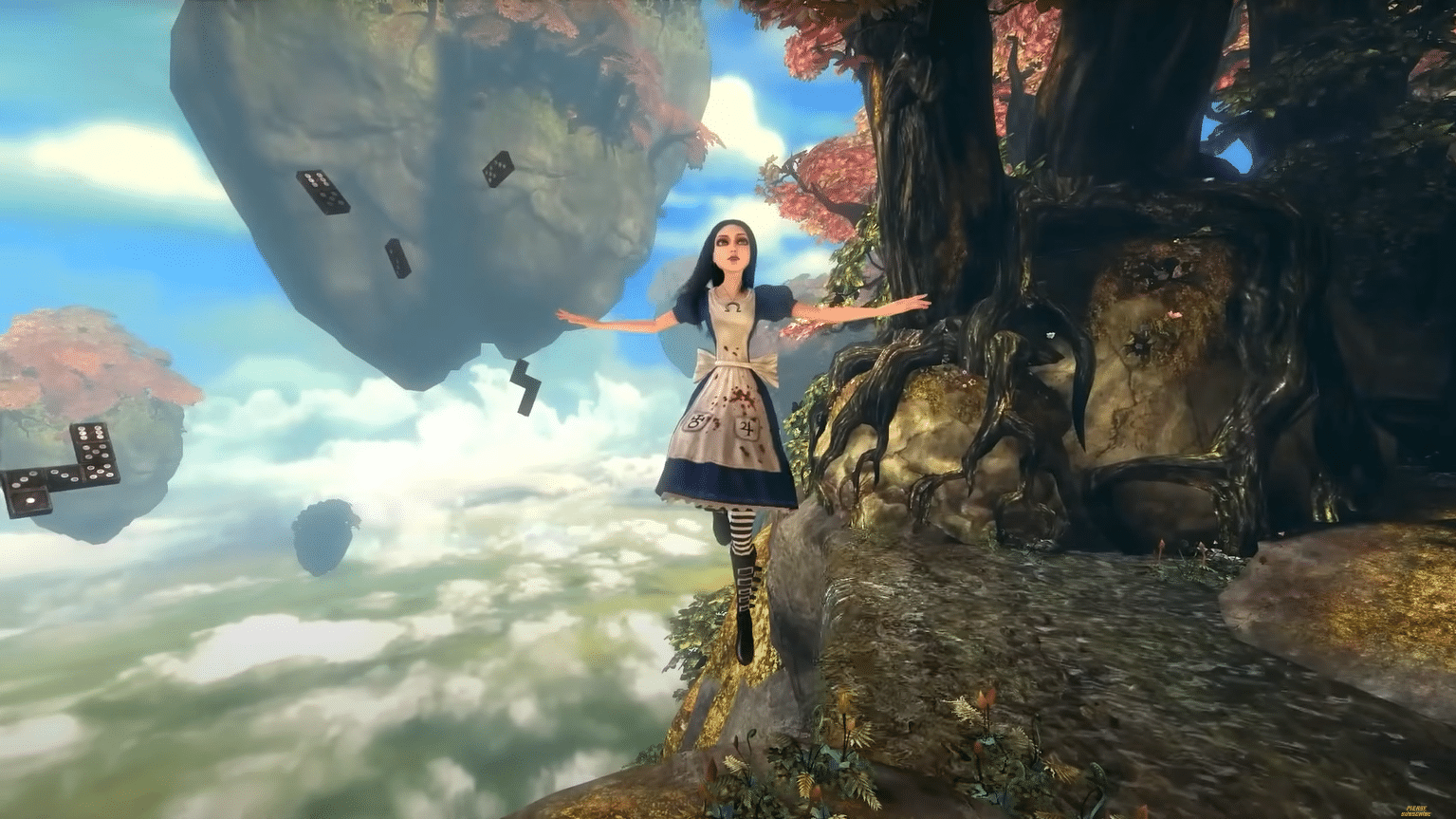
Alice: Madness Returns, on the other hand, suffers from the almost exact opposite problem: it’s too easy. I actually had to bump up the difficulty to hard to feel like I was getting any kind of challenge from the combat. Enemies had very visible “tells” you could notice in battle, and the weapons you acquire can easily be leveled up and made overpowered, defeating basic enemies with a single hit sometimes. The combat itself was also significantly improved, with the weapons each feeling distinct and having their advantages, making the fights themselves more strategic. Additionally, Alice controls much better now, with her movement actually having some weight to it, and the triple-jump made traversing the levels much more enjoyable.
This game is gorgeous and bursting with creativity in its design. Wonderland is back and weirder than ever, and your journey takes you to some very interesting places. Hatter’s Domain, the Oriental Grove, and the Infernal Train are all wonderfully imaginative and fun to explore, while the Dollhouse is disturbing to an entirely new level. Alice also unlocks a unique dress in each level. My particular favorite was the Siren Dress, unlocked in the Deluded Depths, replete with bioluminescent frills and an anglerfish skeleton instead of a bow.
Madness Returns follows Alice after the events at the asylum, where she lives and works at an orphanage under the counsel of a psychiatrist, aiming to help her forget her traumatic past. The story is told as she shifts between reality and Wonderland, trying to unlock the truth of her family’s death. Throughout the course of the game, she recovers these memories and those of significant people in her life. These memories are just one of the many collectibles hidden throughout the game for players to find, along with bottles, pig snouts, and Radula Room challenge levels. These collectible items add something that American McGee’s Alice is missing, which is that explorative element. In the first game, the levels can be difficult to navigate, and there’s no reward for scouring every corner. But Madness Returns has all of the aforementioned collectibles, making maneuvering through the levels much more fun.
I had an inverse experience with these games. The first one, while unquestionably difficulty, was extremely rewarding to finally conquer, while the sequel was much easier to get through and not as satisfying to overcome. Instead of being disincentivized to explore levels in the first game, the second makes searching for secrets rewarding. Whereas the original game had lots of bosses, Madness Returns only has one in the final boss. A strangely balanced experience overall, apropos to the strange nature of Wonderland itself. I’d like to see a follow-up someday, but given the games’ endings, I’m not sure where the story could go. I have no doubt McGee can come up with something appropriate, but how far down the rabbit hole will Alice go?
Mass Effect has been an influence on me like nothing else. I was introduced to the series with the very first game back in 2007 and I was immediately enamored. The (at the time) lifelike graphics, the vast galaxy to explore, the story about struggling for survival, and the substantial cast of characters had me hooked from the very beginning. Every time I played through it again, I would discover something new; an assignment on a previously-undiscovered planet, or by completing a mission (or missions) in a certain order, the rest of the game would acknowledge that specific order. I’d never experienced anything like it up to that point, and with the rare exception of a few games, I haven’t felt it since.
Obviously, my love for the series extends beyond the first game. The trilogy (and Andromeda, although controversial) are among my favorites across all of the digital realm. It’s what inspired me to go into writing, what drove me to become obsessed with video games, and is most likely responsible for the individual I am today. It’s weird thinking about a piece of media that way, but Mass Effect has probably been the single-largest influence on me, as far as pop culture is concerned.
So you can imagine my surprise when, nearly 14 years after the original game’s release, we not only saw a trailer for The Next Mass Effect, but the announcement of a remastered trilogy, with full-HD graphics and quality-of-life improvements. You can also imagine that I purchased it immediately as possible and completed every game to 100%.
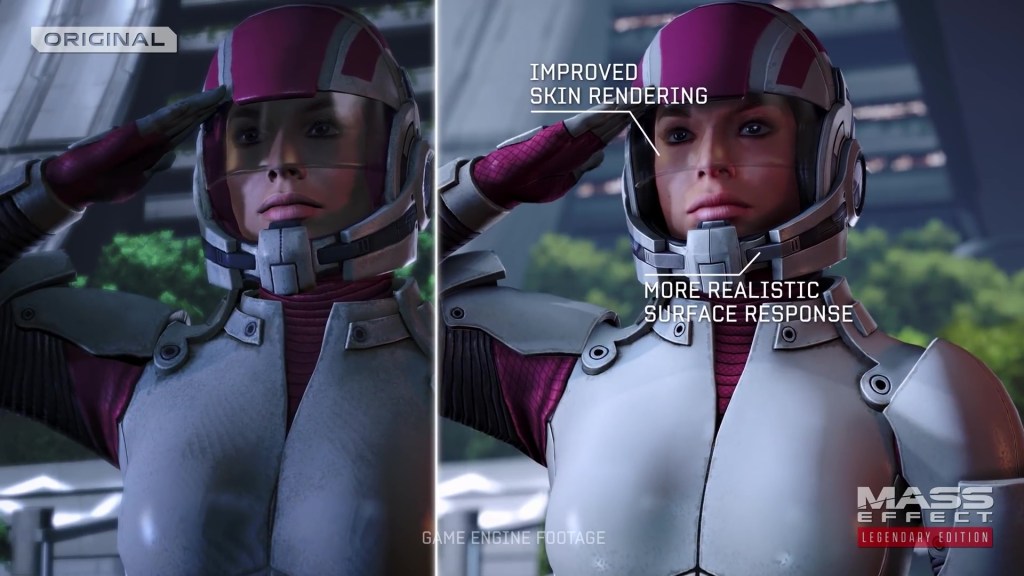
First of all, I am blown away by how great the game looks even after all this time. Yes, everything is displayed in 1080p and with high-resolution textures, but it’s all upscaled from the original. You’ll spend hours, like I did, just revisiting all of your favorite places and seeing how they’ve been updated. The sprawling vista of Zakera Ward and the vast snowscape of Noveria are even better than they were before, but now, you can see fine detailing on the Prothean ruins on Therum, or the wrinkles on Shepard’s face as they respond to someone in disgust. All of the games have been updated to have a visually-consistent theme, too. The default FemShep is available from the start, and Eden Prime looks like it does in ME3. These don’t just feel like separate games in a trilogy now; it feels like one, large, epic saga.
ME1, as expected, had the most significant changes and adjustments made to it. Since it was the original game in the series, BioWare was still trying to figure out what kind of game it was going to be, whether RPG or shooter or somewhere in between. The end result was a clunky and awkward battle system with pieces of cover constantly flying around. Now, however, the gameplay is more reminiscent of ME2 or ME3, with much tighter shooting and ability control. Plus, reworked levels mean that the geometry won’t suddenly change when you use a biotic Throw. The GUI has also been updated to be consistent across all three games. But the biggest single change is probably the Mako.
Fans of the original Mass Effect know what I mean, and I’ve probably triggered a few PTSD flashbacks just by mentioning it. When traversing unexplored planets, you make your way in an all-terrain vehicle/tank hybrid. The problem was you couldn’t drive the damn thing. You might sometimes head in the direction you’re pressing the control stick, but often, you’ll veer off course and go spiraling down a mountain. And the mounted gun was fixed at an angle, meaning that if enemies were below or above you, you would have to change the elevation of the vehicle to attack them, not just adjust the angle you’re aiming at. I am happy to report that now, the Mako behaves like an actual, drivable vehicle. It goes where you want it, it fires where you shoot, and they added a forward boost alongside the original vertical boost. Having a working game mechanic might not seem like much to ask for, but I am grateful that now I can trek new worlds without my biggest fear being the traction.
ME2 and ME3 also received some changes, although much more minor compared to ME1. For one, the Extended Cut is built right into the game, meaning the original cut of the endings are no longer available. Fine by me, honestly. With the multiplayer removed, however, players will have to complete the majority of the game to achieve total Effective Military Strength during the final assault. Hopefully, BioWare will include the multiplayer portion again, which would be more than enough reason for me to resubscribe to PlayStation Plus.
Across my latest playthrough of the trilogy, nearly half of my time was spent in Photo Mode. I loved taking action shots of the squad in battle, or capture the wide landscapes of some visually stunning planets, and it gave me the time to appreciate many of the small changes and details across the games. I’ll post a gallery of my favorites at some point. I would spend up to an hour reangling the camera, or changing the filters, or shifting the blur and bloom effects, trying to find the perfect picture. But even then, it didn’t feel like wasted time. Every second I spent playing them was a positive experience for me.
And that’s probably what I’ll take away most from the Legendary Edition: this is the definitive way to reexperience my childhood. Instead of just staring at starscapes, I could capture pictures of them. Instead of trying to make a custom FemShep that looks like the default in ME3, I can use the default from the very first game now. All of the DLC was included, and BioWare even kept in many of the glitches and exploits from the original games, meaning it’s still possible to break out those dominant strategies from 2007. Mass Effect opened my eyes to a whole new universe of gaming, and being able to reencounter my favorites with a bright coat of paint is something I cherish.
I’ll never forget the first time I walked over the hill and saw Sovereign. It still sends chills up my body every time I see it.
I’ve never been much for blogs, mostly because I’m terrible about updating things regularly. I like working in bursts, getting a whole bunch done at once and then take time off. But I came to the realization that it doesn’t matter how often I add to this. The blog can stand as more of a record, for self-posterity, than anything else, kind of like an online journal.
I don’t imagine this becoming much more than an account of all the games I play and my ideas about them. Even if no one else reads these, I need to put my thoughts down somewhere. I’ll try not to spoil them, in case anyone is actually interested in checking them out, but if one or two sneak through, that’s on you for reading about something you haven’t actually played.
How well will this go? Only one way to find out, right?








 LAFworks