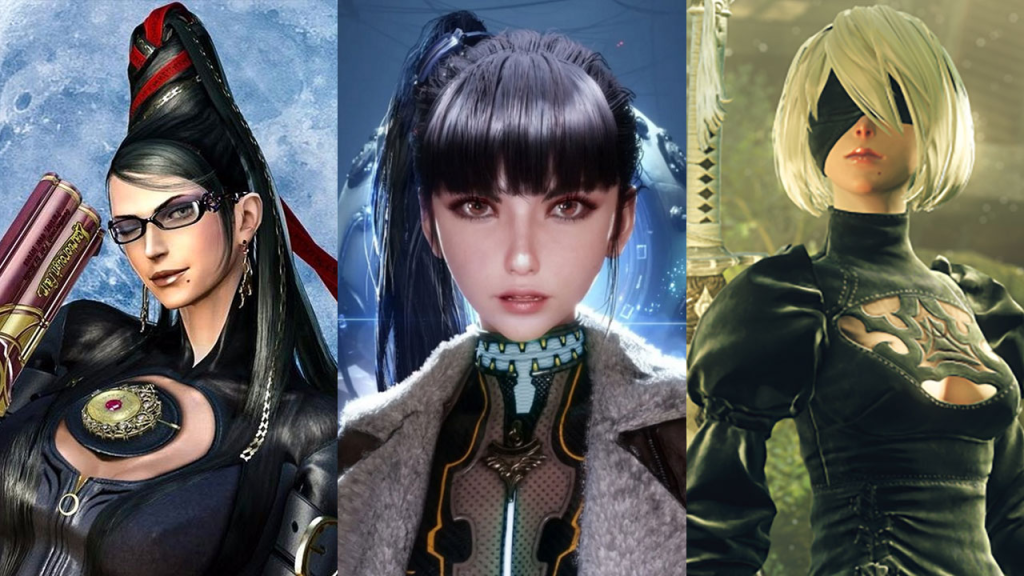
Hack-and-slash, combat-focused, over-the-top spectacle. These terms are all used when describing the wide catch-all net of character action games (CAGs), which prioritize mastery of melee combat, usually contain a massive variety of combo attacks players can use, and often evaluates those techniques with a score or points system. Within this field is an emerging subgenre of what I call sexy action games, where the protagonists of these combat-driven games are attractively designed women. This wasn’t supposed to be a discussion on whether games like Bayonetta, Lollipop Chainsaw, and Nier: Automata should be made, or the design philosophy behind creating a purposefully beautiful woman as a protagonist; rather, my intent was to introduce you to the topic at hand as a prelude to why discussions about Stellar Blade‘s merits as a game exist, and from there, focus solely on the game itself. Unfortunately, the two topics go hand-in-hand in today’s ever-charged world.

Eve, a member of an airborne squadron of cybernetically-enhanced fighters, is dispatched to the remains of Earth to fight the Naytiba, a parasitic alien race that have taken over the planet and wiped out humanity. With her squadmates being slaughtered around her, Eve is saved by the appropriately-named Adam, a human living in the last known major settlement on the planet. Eve needs to discover the true source of the Naytiba, why Earth became a warzone, and the purpose of her own existence as she takes on the threats to humanity’s legacy. She carves her way through enemy minions and monstrous bosses in order to save humanity from dangers that seek to rewrite history.
As with other character action games, combat is the primary focus of the gameplay. Using a unique hair ribbon that doubles as a sword and a drone which can convert itself into a gun, you start off with only some basic attacks, a parry, and a couple of special moves. Through understanding the back-and-forth clashes between enemies, you open yourself up to new abilities and movesets that widely expand your approaches to defeating Naytibas. Sometimes, you’ll want to sneak up on one to take it down in a single attack, or try to fire at it from range to draw it out from the group its sticking in. Like other CAGs, combat is ultimately where the game shines brightest, although the gunplay itself is limited and feels more like an afterthought. Dueling a boss one-on-one is where the game feels most alive, blocking attacks to whittle away the stamina meter until you can blast away a chunk of its health all at once. Akin to Jedi: Fallen Order or Sekiro: Shadows Die Twice, combat feels like a relationship between the player and their enemy. Unlike those games, however, Stellar Blade is much easier overall. Although I certainly didn’t make it through without dying, I felt as though I began to breeze through the game by the end, massively over-leveled and with every upgrade. It takes a while before you really feel like you’re able to dance in battle, pirouetting between enemies, leaping with graceful slashes into ostentatious finishers, but it’s worth spending the time to get a feel for it all.

Objectively speaking, Stellar Blade is just gorgeous. The environments really capture the various settings, whether the overtaken ruins of a megacity, the futuristic remnants of lost technological advancement, or the sprawling carcass of the planet, now a vast desertscape devoid of life except for the parasitic Naytibas. Even these creatures are wondrous to look at, monstrous and creative in their designs. Likewise, the NPCs we meet, although humanoid in appearance, are somewhat grotesque, having cybernetic implants replacing major parts of their bodies. Much like in Cyberpunk 2077, it represents both how far humans have advanced as a species and also how much of our “humanity” we’ve lost in the same attempt. Not everything is made to be vile or melancholic to look at, however. Eve herself is given a large number of costumes, hair styles, and accessories with which players can customize her aesthetic, enabling the ability to create wildly different avatars. I found it amusing to try and give her a new outfit every time I earned a trophy, so my PS5’s media gallery would be turned into a fashion show. Some of these outfits made sense (contextually speaking), while others were gratuitous to the point of being purely fan-service. Whether that is a positive or a negative is entirely up to personal preference.
While exploring the vast swaths of land of the open world, you have plenty to do other than gaze at the environments or at Eve. Other than the main storyline, which, while predictable at times, does contain multiple endings, there are plenty of side quests and activities populating the post-apocalyptic world. Very few of the side characters who offer additional missions stand out as memorable, most falling into the same combination of cyborgs. However, the aforementioned multiple endings rely on whether Eve completes these ancillary tasks. In addition, the numerous hidden chests and caches throughout the environments can provide Eve with crafting materials and upgrade components to further increase her combat capabilities, from strengthening her Blood Edge blade to increasing special ability meters.

As an aside, I always appreciate when a game contains a fishing minigame. From Animal Crossing to Like a Dragon: Ishin!, fishing games are a welcome addition. Even if it feels wildly out of place, these moments can break up the traditional gameplay loop, providing the player a moment to wind down and focus on a less intense endeavor than saving the world. Many modern games now walk the line between linearity and open exploration or fall somewhere in the middle. By including little pastimes like this, players are incentivized to not solely focus on completing the story, but to discover what the (end of the) world has to offer.
All in all, this is a genuinely fun game, with a combat system easy to jump into but taking time to master, additional activities and minigames to occupy the player, and customization options to make Eve your very own. Nothing that might cause controversy, correct? I mention all this, spending the time to justify why this game is fine on its own, simply to contextualize things before explaining why this game became so infamous leading up to its release.

A cross-section of the western gamer population has, over the last few years, began to decry the “uglification” of video game characters. Blaming the trend on “woke culture” and “DEI practices,” there are many who believe western game developers are purposefully making female characters unpleasant to look at, as some GameFAQs users write, “so that they can be empowered with confidence, so that ugly people dont think they are left out in society”, or that “Japanese dont care about what SJW or feminist groups have to say”. They create a contrast between western developers’ character designs (Mary Jane Watson, Kay Vess, Abby Anderson, etc.) versus eastern developers’ (Tifa Lockheart, Mai Shiranui, Jill Valentine, etc.). Instead of a conversation about the objective qualities of the game, the world has been focused more on the character’s appearance than her abilities. I’m not going to pretend to try to get into the minds of game developers and why one design is chosen over another. Weren’t we taught to judge books by their covers, that beauty is only skin-deep (or polygon-deep, in this case)? Beyond just the observance of women’s bodies, some of these squabbles are filled with ignorance, like not knowing women can also have peach fuzz; or outright creepiness, like toward a character’s juvenile design; the meme below alone proves my point. Sure, I enjoy looking at beautiful women as much as anyone else, but that won’t determine whether or not I play a game. There’s nothing wrong with enjoying the artful nature of the female form, but there’s also nothing wrong with just wanting to play a game.
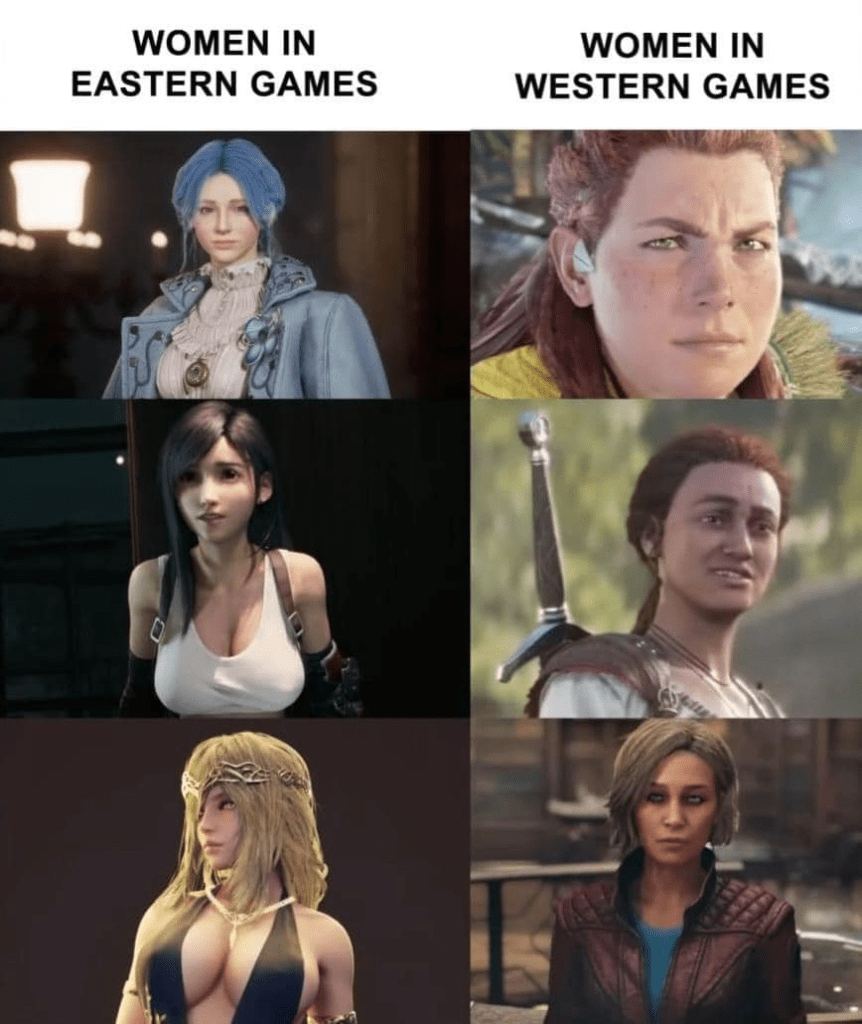
Although I keep repeating myself, Stellar Blade is a solid experience. The combat is fast-paced and takes some patience to master, there are plenty of exploration options and hidden collectibles to keep you searching the maps, and the mystery of the world and how humanity reached its current state are genuinely intriguing. In fact, out of all the games that came out in 2024, this was probably one of my favorites that I played. And that’s part of the problem: I don’t think it would be controversial to make that claim if it weren’t for the discourse around the protagonist. Conventional femininity, whether you consider it a positive or a negative, should not be a factor in judging the quality of the ultimate product, unless that’s literally the whole point of the product. Though now considered to be a prime example of the genre, Bayonetta was simultaneously decried and praised for the eponymous protagonist’s inherently sexualized design. Although designed with the male gaze certainly in mind, Bayonetta herself can be an empowering figure, flaunting her attractiveness as a distraction against her foes.
In fact, this whole discussion is entirely reminiscent of one concerning the 90s’ most popular female protagonist in games, Lara Croft. The topic of the quality of her face and body as both negative and positive-only-in-terms-of-sexuality is, in the end, a distraction and deflection from the conversation about the quality of the actual game. One element of her original design which received plenty of player focus was her large chest, a design choice which was an accident at first: “While making test adjustments to her girlish figure, a slip of his mouse turned an intended 50% increase to her breast size into a 150% gain. It met with instant approval from the team before he could correct it.” Eidos and Sony made that central to marketing the game, and so for many players, it became integral to her design. After the series rebooted in 2013, large sections of fan discussions online centered on her breast size once again, not whether the gameplay was an improvement or the changes to her character made for a more engaging story. Instead of talking about the merits of Lara Croft, we have to talk about her design and whether sexiness should be inherent in female video game characters.
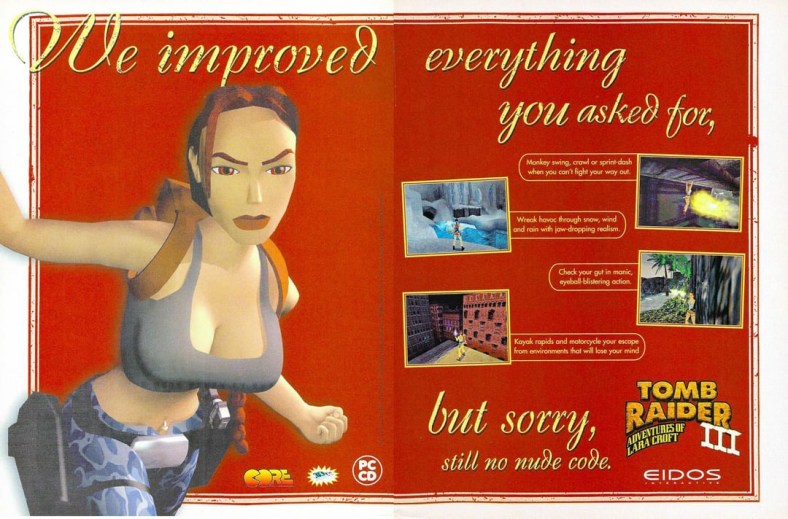
Which brings me to my main point: this was originally meant to be just a blog piece about Stellar Blade; what works, what doesn’t, what I enjoyed, what I would want to see more of. However, talking about this game cannot exist in a vacuum any longer. It will always be tied to discussions about Eve’s design, fairly or unfairly justified. This is a good game, but I can’t focus on it alone because any conversation about the game will lead back to the topic of its protagonist’s aesthetics. So now, I have to take time out of my day to talk about why it’s okay for everyone, whether masculine or feminine or feminist or anything else, to play a game with an attractive female protagonist.
Among the countless controversial topics concerning the game industry is the consideration of whether men should have to play as women protagonists in games. Discounting the fact that women have had to play as men for years without any say, video games are a form of fictive entertainment. They can enhance our comprehension of our own world around us while also being an escape into an alternate reality. If you can suspend your disbelief long enough to play as the sole hero saving the universe from total destruction, you can suspend it just a bit longer for that hero to be a heroine.
 LAFworks
One thought on “Stellar Blade and the Gamer’s Gaze”