If you’re like me and you were a child in the late 1990s/early 2000s, you were probably also a fan of Harry Potter. What was there for a kid to not like? A wondrous wizarding world, replete with magical creatures, enchanted everyday items, and the promise of a spellbound education. It was more than enough for kids to start drawing lightning bolt scars on their foreheads (me included). Despite the horrendous attitude the author now has toward certain populations, the franchise still holds a special place in my heart. Any person my age would have loved to have been transported to England and attend the mystic academy of Hogwarts School of Witchcraft and Wizardry. All these years later, Hogwarts Legacy allows me to vicariously fulfill that dream even to a small extent.

Under unusual circumstances, the player begins their magical education as a fifth year. With the guidance of Professor Eleazar Fig, you discover an innate ability to sense a kind of ancient magic in the world around you as you are swept up in an ongoing conflict between wizards and goblins. As you try to discover what the rebellious Ranrok is trying to uncover, you must also devote your time to your classes, learning new spells, developing friendships, and expose centuries-old secrets that could upend the balance of power in the world.
After a short tutorial on basic spellcasting, you finally arrive at Hogwarts and are sorted into one of the four houses: Gryffindor, Hufflepuff, Ravenclaw, and Slytherin. Each house’s common room is vastly different and suited toward the different types of students: Ravenclaws have a vast arcane study, Slytherin slink in the depths below the castle, and so on. While each of these rooms are gorgeous and unique, you won’t be spending much time there, which is a somewhat-wasted opportunity. Instead, you spend the following days familiarizing yourself with the castle layout, learning new spells, concocting potions, and supplying yourself with magical accessories, including your own wand. The level of customization and cosmetics available is quite impressive, allowing you to create individual avatars that will have their own special experiences throughout the school year. The character and wand creators have vast options, ensuring that your time and experience in Hogwarts is unmatched to anyone else’s.

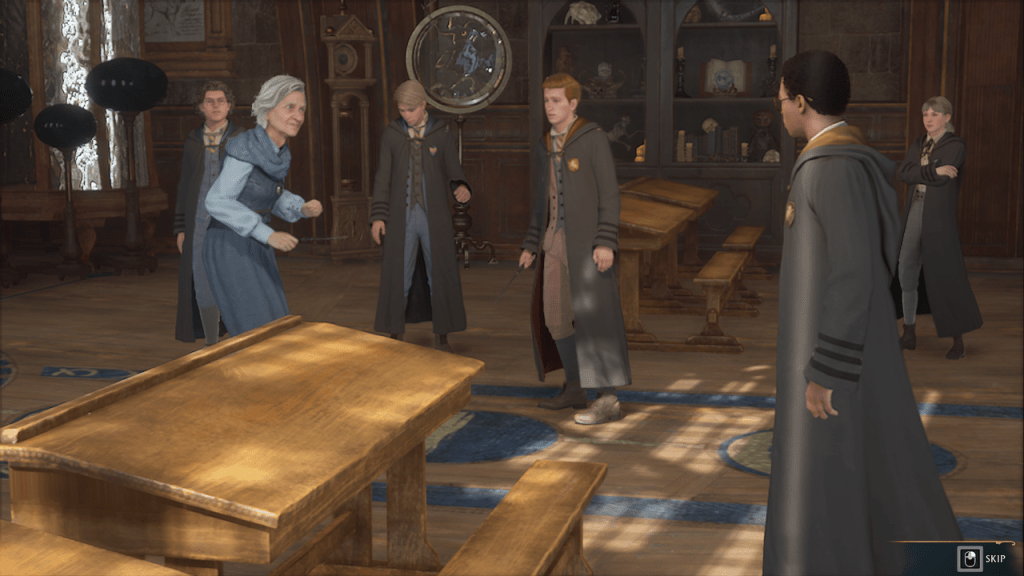
In order to catch you up to the other students’ levels, you’re given a Field Guide, essentially a magical codex that gets filled with more and more information as you find new pages or items. There’s no purpose to filling out your guide, other than for completionist’s sake, and there are an inordinate number of challenges to complete and items to acquire to fully complete it. It takes a lot of busywork to fill out all the pages, but I suppose that’s also part of the point, to help amplify your magical repertoire and bring you to where a fifth year should be. As you complete your guide, however, you’ll find yourself journeying through the massive game world. The best part is being able to explore the castle grounds, the village of Hogsmeade, and the sprawling Scottish Highlands outside the castle. Mysteries are hidden around practically every corner, with puzzles to solve and treasures to find. You may find yourself face-to-face with the poltergeist Peeves, harassing students at every opportunity, or you may find a secret passage that requires clever thinking in order to uncover the enigmas within. Once you unlock flying mounts, like the broomstick, you’ll find yourself soaring through the air, across the forests and lakes, and simply taking in the beautiful locations around you. Each section of Hogwarts and Hogsmeade is beautifully rendered, providing you with hours of wandering from class to class. The courses themselves should all be familiar to fans of the series: Charms, Herbology, and, of course, Defense Against The Dark Arts. Each professor has special spells to impart upon you, widening your array of abilities that will aid you in your excursions and adventures.
Likewise, you’ll meet many fellow students during your time in Hogwarts: bold Gryffindors like Natsai Onai, loyal Hufflepuffs like Poppy Sweeting, or conniving Slytherins like Sebastian Sallow. These three students in particular will offer their own relationship storylines, enabling you to help them grow and overcome their shortcomings while taking you across the Highlands. You may find yourself requesting assistance from centaurs in the Forbidden Forest, rescuing dragons from underground fighting rings, or battling dark wizards and goblins trying to use the land’s resources for their own selfish benefit. These moments are when the writing really shines through, exploring the complexities of living in a world where magic is an everyday occurrence. Other students and citizens will offer side quests of their own, further allowing you to delve into the landscapes, solving riddles or battling beasts. These may not offer the same depth of reward or story arcs as the main relationships, but they help to further establish the lore and mythos of the wizarding world, if you can get over the obnoxious nature of people like Arthur Plummly or Zenobia Noke.

The main story, however, does not scratch many of these same itches. For an ancient mystery with conspiratorial plots, I was hoping for more twists and turns that would give me a sense of uncovering the truth of what took place centuries ago. Unfortunately, it’s a rather basic and straightforward plot. The villains are one-note in their motivations, you never have to worry about whom you can trust, and the tale of the Keepers ends up being rather predictable. Maybe this is meant to reflect the somewhat simplistic nature of the narratives in the Harry Potter books, but even in those, you couldn’t take for granted everything that was put in front of you. There would be unexpected moments that would make you question your perspective up to that point, like what Sirius Black is really up to or who put Harry’s name in the Goblet of Fire. Ranrok and Rookwood simply want to gather power for their own ends, and you’re simply trying to stop them.
Between missions, when you need some down time or want to do some crafting, you eventually have the Room of Requirement at your disposal. Instead of your House common room, you will get to use a magical chamber that provides the user with whatever they may need. You can customize its appearance and features to your liking, decorating it according to your own preferences and filling it with potion tables, potting stations, magical looms, and creature vivariums. Throughout the world are all sorts of conjurations that allow you to further tune its characteristics with small items of flavor, like game tables, artwork, and bookcases, to name a few. These conjurations don’t add any new attributes or abilities, but allow you to alter the room to your own liking. I primarily found myself using it to identify items or gather materials from the beasts I saved, but for your own private hideaway, there are quite a number of options available to make it your own.
My experience with the Room of Requirement actually is a strong summation of my overall time with the game: there is a ton of ancillary content you can access if you wish to dedicate the time to it. None of it is wholly necessary, but it adds to the character of the game’s world. Whether you’re taking in everything the wizarding world has to offer, or you just want to get every achievement or trophy, the sheer amount of content can be quite staggering. However, Hogwarts Legacy is what you decide to make of it. If you just wish to go to classes and complete the main story, that’s fine. If you want to complete your Field Guide, more power to you. Or if you just want to fly on the back of a hippogriff, go right ahead. The magic, I guess, is in the experience.
 LAFworks