I know what I’ve said in the past about Blizzard Entertainment and Diablo, about not knowing whether I would continue to support the company. You have your answer, I suppose.
Blizzard games have been a major facet of my life, from being frightened by my older brother’s taunting of me by saying, “Diablo’s coming to get you,” to literal months spent on World of Warcraft characters over the course of twelve years. Perhaps my anger toward the company had faded, or perhaps my nostalgia for their past hits made me hopeful for the future, I purchased Diablo IV, played it thoroughly, and stepped away for a while, complete but not satisfied.

The latest in the series of angels warring against demons, Diablo IV brings players to the continent of Estuar, across the sea from Khanduras, where the first three games mostly played out. By random chance, your fate is tied to that of Lilith, a demon who helped create the world of Sanctuary that humans inhabit. As she plots a way to destroy the Prime Evils by empowering humanity through hellish rituals, the player chases her and her conspirators down, all while begrudgingly assisting the Lord of Hatred and father of Lilith, Mephisto. Slaughtering their way through scores of monsters, demons, undead, humans, and more, players gradually become more and more powerful and acquire better and better loot in order to face increasingly difficult challenges, culminating in battles with god-like beings.
It seems as though the original intent was to create a game more similar to Diablo II than III; slower paced, a deeper and more methodical leveling system, and large swathes of land to explore. However, some of the initial choices, while appearing to be a return-to-form, makes one scratch their head in confusion as one thinks deeper about the mechanics. Combat is supposed to feel strategic, a back-and-forth with groups of enemies, but my characters always felt too sluggish, even when they were built toward agility. It always felt as though the creatures would be running circles around me while I’m wheezing and puffing just trying to keep up. This wouldn’t be the worst thing, if the attacks felt weighty and significant and could greatly damage my opponents. Apart from feeling slowed down, my characters also felt supremely weak. Being outfitted with legendary equipment all modified toward specific playstyles didn’t help much to increase my capabilities either. Even in Diablo II, which utilized a stamina system allowing players to temporarily sprint, meaning you would be moving much slower otherwise, as you increased in level and acquired new gear, these mobs of enemies would just crumple into piles before you. Diablo IV made combat feel like an always-uphill battle, but never in a good way where you feel as though you’re overcoming challenges and getting better at the game, but more as though you’re slogging through mud, just trying to get a little further.
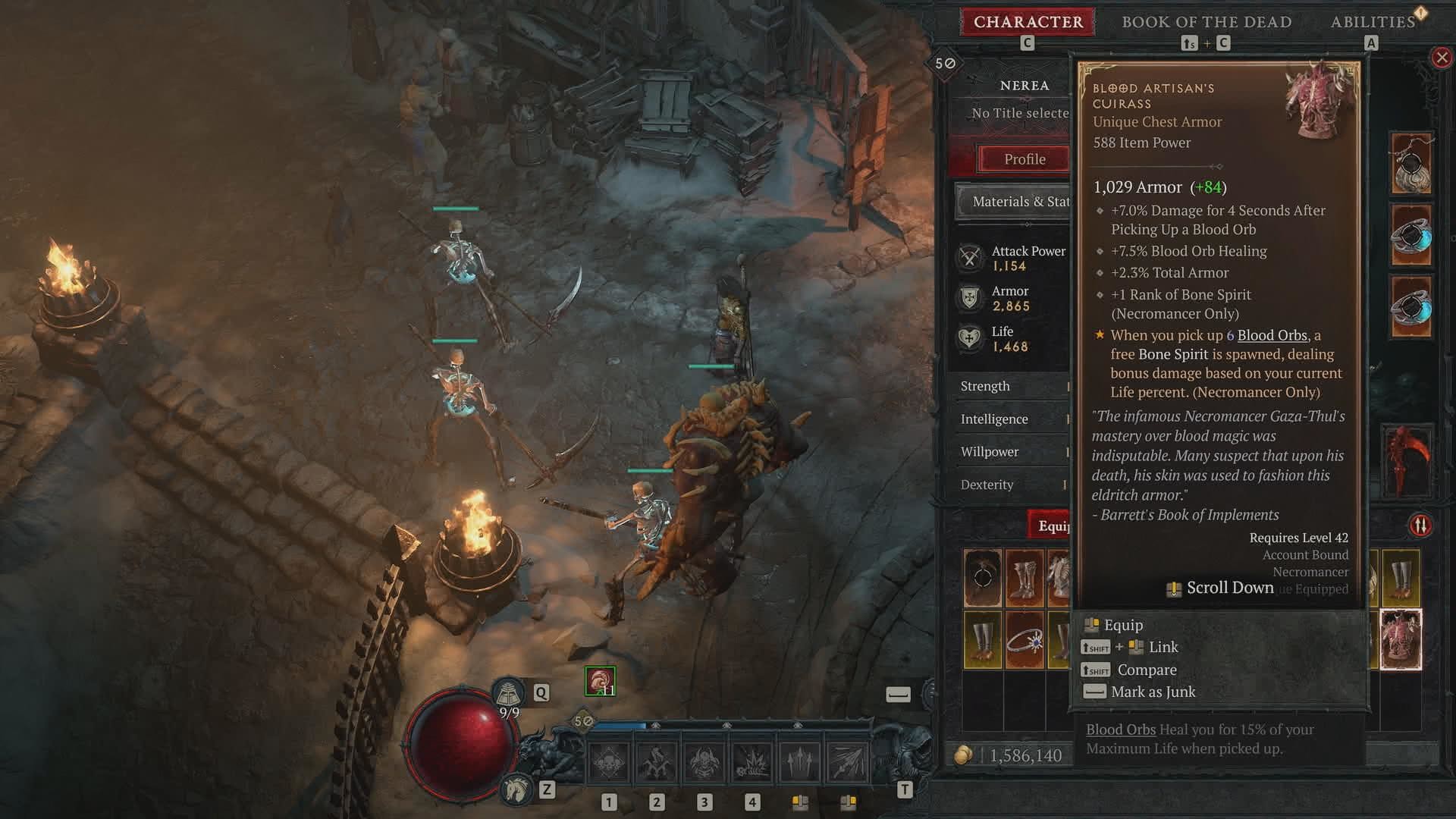
The continent of Estuar is one continuous, open, traversable environment, where players can cross all the way from the southern reaches of Hawezar to the northern shores of Scosglen without interruption. As a result of having a single map for all players, however, this meant the random generation of zones which had come to characterize the series thus far had been all but eliminated, with the exception of the dungeons. Unfortunately, this critical aspect of the game had been stripped down to the barest level possible. None of the levels varied in layout very much, all using the same tilesets and graphics; castle-like areas, cave-like areas, basement-like areas, with no variety or changes in design. Each had the same objective: kill a certain number of enemies or gather a certain number of items, reach the next floor, repeat, and then kill a boss creature. Couple this with a loot system where players never felt empowered, and the reward of completing these dungeons would lead to tepid excitement at best, and indifference at worst. Exploration had been majorly restricted, and there were now no real prizes to be earned from exploring, apart from the occasional stat-increasing Lilith statues.
That’s not to say that it was all bad upon release. In keeping with the attempt at a more Diablo II-esque tone, the graphics and visual style were much darker than in III, with a focus on the horror and demonic elements of the franchise’s roots. Gore was highly detailed, the atmosphere was utterly bleak, while each environ felt unique and memorable in their own rights. The narrative had also been given a substantial overhaul, with far more cutscenes showcasing interactions between players, companions, and various other characters, emphasizing these moments and scenes as meaningful as opposed to the basic dialogue windows otherwise experienced. Overall, Diablo IV was a step in the right direction for Blizzard, but at least for me, it still felt lacking. That doesn’t mean I didn’t take the game as far as I could during my first time with it. I tried every character class, finished the main story and epilogue, even fully completed the first limited-time season journey shortly after the game’s release. But once I had done so, I felt no reason to return to the game. I felt as though I had exhausted my desire to play and would move onto something else. And so, I did, for a while at least.
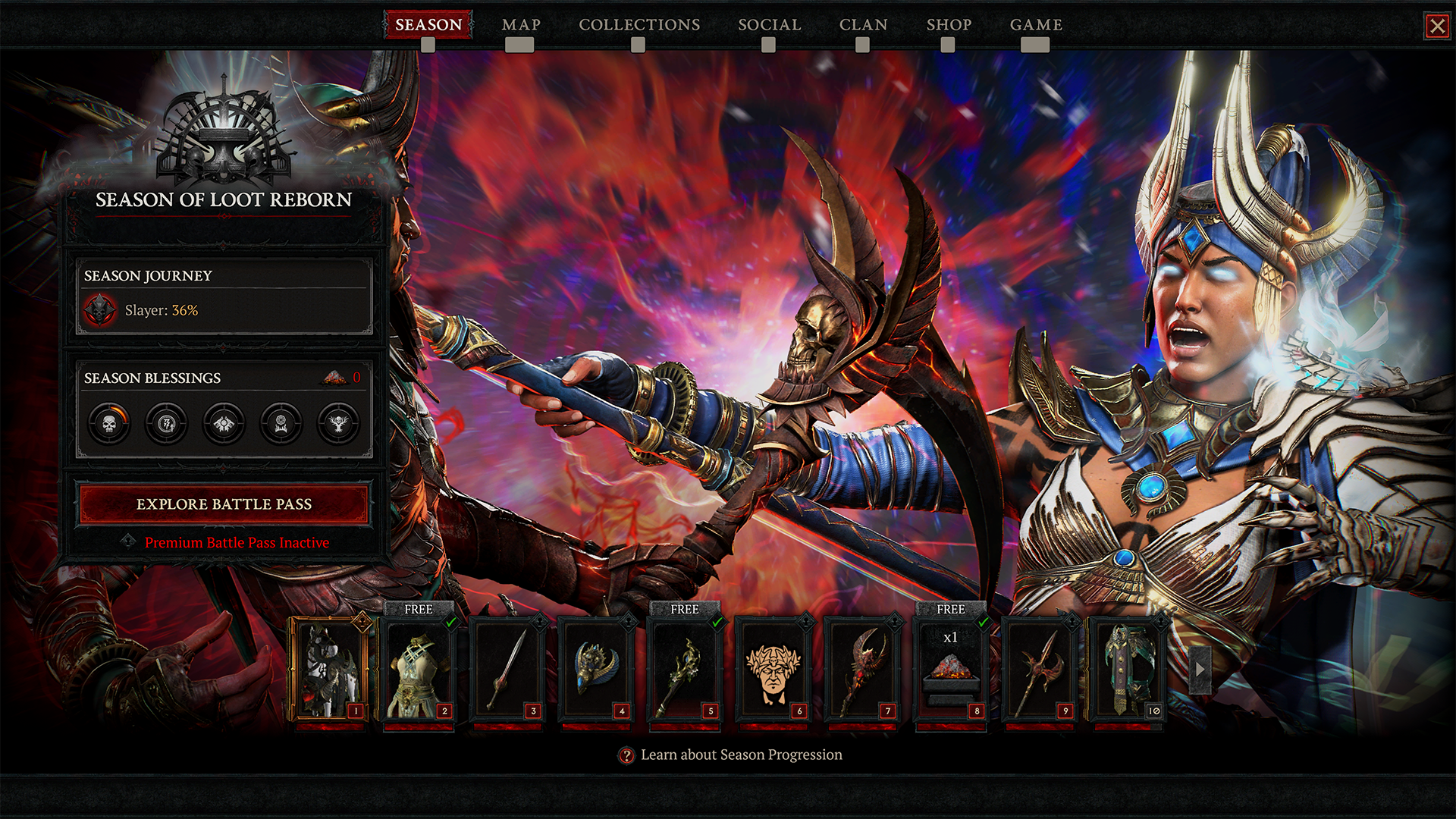
Season IV of Diablo IV, starting on May 14, just weeks before the game’s one-year anniversary, was named “Loot Reborn,” bringing about perhaps the most colossal and considerable changes to date. The stat system was streamlined in order to make selecting quality gear much easier, in addition to the rare Greater Affix weapon with even higher bonuses. Enemies spawned in much larger groups and more often. All of the player’s abilities were given more power, making it actually satisfying to fight through these hordes. Equipment could be customized even further, allowing players to modify them at blacksmiths and further tune them to unique builds.
This is what I had been hoping for and expecting when Diablo IV first came out. It felt good to fight through enemies, it felt good to find loot, it felt good to level up and acquire new abilities and talents. For the first time, the game truly “clicked” for me, and that was a moment of profound realization.
Although I dislike the idea of game publishers releasing titles too early, before they are really completed, have been tested, are free of any glitches and technical issues, and are, most importantly, fun and enjoyable to play, something which happens far too often in today’s market, developers still have the opportunity to fix and fine-tune the games until they are a gratifying experience. It happened with Final Fantasy XIV, it happened with No Man’s Sky, it even happened with Cyberpunk 2077 (another title I will have to revisit), and now it’s happened with Diablo IV. One can say it’s in order to satiate investors and board members, patching issues that should never have been present in the first place just so executives can make their profits. But it’s also possible for one to say that this shows developers never losing hope in their projects, that even if something isn’t perfect upon its initial release, it can become something better, provided it’s given the opportunity.
Imagine if ET: The Extra Terrestrial for the Atari 2600 had been given a 2.0 version. Wait, no, nevermind, forget I said anything.
 LAFworks