Over the last 20 years since I started getting into video games, I’ve probably played well-over 150 separate games, everything from action-packed shooters to choose-your-own-adventures. Every so often, I find myself yearning to play one of these classics again. Modern games have many quality-of-life improvements and many more hours’ worth of content, but there’s a reason that some titles stand the test of time while others are only good for a single playthrough. This is part of a series of entries wherein I talk about games I’ve already played numerous times over the years, but now taking an even closer examination into them. While some of the games I’ve written about before are just as old, it was my first time playing them when I wrote about them. These games, I’ve beaten multiple times and tried to experience everything the game has to offer.
Star Wars is, I truly believe, the reason I am who I am today. I’m pretty sure it wasn’t the first movie I ever saw as a kid, but it’s the first movie I remember having watched, the first movie I remember the experience of watching. It had everything I love: science and space elements, a fantastical world filled with vibrant characters and locales, and an easy-to-follow narrative of good overcoming evil. If it weren’t for Episode IV: A New Hope, I probably wouldn’t be the person I am now. While this love didn’t carry over to include the prequels that were coming out while I was a child, it did come to include video games, which I was starting to become interested in. Luckily for me, one of the perfect titles to engross me into the interactive world was just about to come out. From the moment I first started playing Star Wars: Knights of the Old Republic, I knew this would be another part of the franchise that would greatly affect me.

Taking place thousands of years before Luke Skywalker and the Rebel Alliance, Knights of the Old Republic showcases an era of Star Wars not yet previously explored by any media: a time when Jedi and Sith were numerous across the galaxy. Weakened by the recently-concluded Mandalorian Wars, the Galactic Republic and Jedi Order were not ready for the Sith Empire to emerge from the shadows, having converted two of the Jedi’s greatest war heroes, Revan and Malak. As this conflict spreads across the galaxy, players take control of their character as they decide the path of their own story. Whether altruistic and a servant of the Light Side, or selfishly cruel as a master of the Dark Side, the game provides players with countless dialogue and gameplay choices that influence how the narrative unfolds. As you put together a crew and explore the galaxy, you uncover secrets that could lead to the downfall of both the Republic and the Empire, and it’s up to you to decide who will be victorious.
Up until this point in my life, the only choice really afforded to players in games was single-player or multiplayer. KotOR was the first game I ever saw that allowed the player to choose what their character said, where they went across the galaxy, how they completed missions, even what they looked like. It was at this point that I realized how open games could be. Not everything needs to be static and unchanging, like trying to reach the end of a stage. Now, the very experience of the game, your own perception of the story, would change based on the choices you made. This would only be my introduction to the amount of player agency BioWare would employ in games. But it was not only how I reacted to the choices, but how the game reacted. Party members will comment on your actions, whether they approve or disapprove; the state of the galaxy and the fate of certain planets would be affected by who you decided to aid; even how the final level plays out is determined by the choices you make. For the first time, I felt immersed in a game, like I was truly there. For the first time, I had an impact on how the game is played. And let me tell you, that was mind-blowing for 10-year-old me.
Of course, it’s the cast of characters you meet that truly color the experience for you. Luke had Han Solo, Princess Leia, Chewbacca, C-3PO, and R2-D2, just to name a few; you should expect to be followed by your own crew of miscreants. HK-47 is a fan favorite, myself included, but Jolee Bindo and Canderous Ordo, among others, have gained cult status among players in the know. From street urchins to grizzled veterans, from optimistic padawans to antagonistic assassins, you will pick up a wide variety of characters as you travel across the galaxy in your own spaceship. Although you can only take two companions out with you at any time, you’re free to change up which companions you bring out based on your own gameplay style. You might want to have a droid in your group to take care of all of the security and computers, or you might want a Mandalorian who will take on the brunt of the forces. Again, the choice is what ultimately matters.
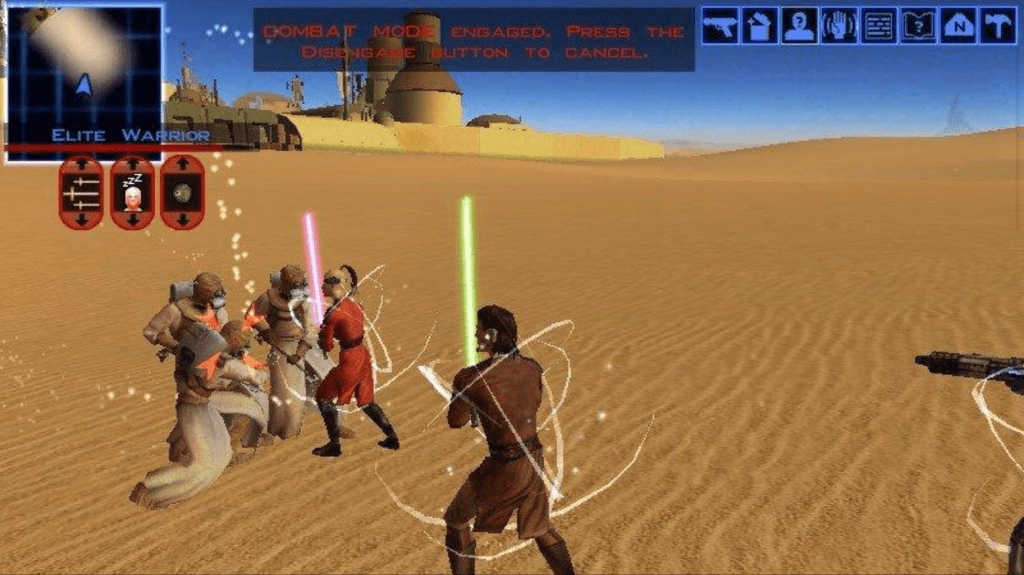
As a fan of Dungeons & Dragons, the gameplay mechanics both drew me in and went over my head with their complexity. When creating your player-character, you are given freedom to select their baseline stats, what weapon proficiencies or abilities they may have, and what skills they can utilize. Combat and certain skill checks are determined by a D20 system, with the game internally “rolling a die” to determine success or failure. You can influence the rolls somewhat by what abilities you use or passive upgrades you have, but never being able to actually see the results of the roll is somewhat annoying. Once it’s determined as a success or a failure, the characters will damage their opponents or affect how the combat plays out. It’s important that you pick your gear to match what abilities you have. Don’t try dual-wielding if you don’t have Two-Weapon Fighting, as it will decrease your effectiveness with both weapons. The player can also queue up moves before they take place, since combat works via a pseudo-turn-based system. Unfortunately, the process of pausing, considering your actions, queueing up the ability, and then waiting for it to occur slows down the pace of the game quite a bit. It makes fighting enemies more tactical, much like a tabletop RPG, but unless you have experience with turn-based combat like in Final Fantasy, it can feel like it bogs down the game. Everything else is decided by the number of points you have invested in each skill. As an example, if I want to slice into a computer, I need to have points in the Computer Use skill, and with every 4 points I put into it, the fewer computer spikes I will need to complete the hack. Certain skills like Computer Use, Persuade, and Treat Injury are vital, but others like Demolitions or Awareness don’t factor into the gameplay as often.

What truly captivated me the most when I played, however, were the worlds I visited. Familiar planets like Tatooine and Kashyyyk make appearances, but you also get to explore the sea planet of Manaan or the Sith homeworld of Korriban. Every planet has a unique feel and environment to it. They don’t just look different; they feel different and act differently. Tatooine, outside of the Anchorhead settlement, is nothing but vast deserts you can get lost in and ambushed by Tusken Raiders. On Taris, the ecumenopolis (fancy word for city-planet) the game starts on, certain areas are only accessible if you have approval from the Sith authorities. It is a common critique of Star Wars that every planet only has a single biome; after all, Earth has numerous different climates, with unique flora and fauna for each. To that criticism, I only have to say: Star Wars is space-fantasy, not science-fiction. If you can suspend your disbelief about Jedi and hyperspace travel, you can extend that to include planetary environments.
To this day, Knights of the Old Republic still contains some of my favorite characters and moments from across the entire Star Wars franchise. Darth Revan and HK-47 will always stick with me, as will exploring the excavated tombs of ancient Sith Lords or gazing out across the endless sea outside Ahto City. While this game looks and feels as old as it is, I can’t help but replay it every few years.
 LAFworks