UPDATE 11/29/2025: This list originally did not include Assassin’s Creed: Mirage. It has since been updated to contain this new entry (Shadows will be added at a later date). In addition, Valhalla was originally listed at number 7 and Revelations listed at 8, but have been moved to accommodate Mirage.
My relationship with the Assassin’s Creed franchise has been, to put it to a word, tumultuous. I discovered the first game around the same time as I discovered Mass Effect, my older brother having picked them up at a BestBuy. While he wasn’t as enamored with it and put it down after a while, I was enthralled, though obviously not to the same extent as Mass Effect. The prospect of traveling through time, experiencing Jerusalem and the surrounding areas during the Third Crusade, parkouring and freerunning from place to place, was more than enough to capture my interest. Add to that the shock inclusion of a precursor race and apocalyptic events, and as an easily-influenced young teenager, I became hooked.
Since then, my feelings toward the games has gone up and down. While there were many high moments in the series, many games I was legitimately surprised to end up enjoying, there were equally as many that fell flat and did not achieve the same level of greatness.//there were equally as many that fell flat and did not live up to the high standards the franchise was known for, be it because of a yearly release model, microtransactions, core design changes, or a shifting of scope.
I will be ordering the games in the series, from my least favorite to most favorite. I am only including mainline entries in this list, so spin-off titles like Assassin’s Creed III: Liberation, Assassin’s Creed: Bloodlines, and Assassin’s Creed Chronicles will not be discussed here. This does not necessarily reflect the quality of the game itself, although I am ordering this list based on my enjoyment of the game. This is all according to personal preference. Some of the factors that I used to determine these rankings include: critical acclaim, additions to the franchise, quality of the story, cast likeability, and quality of side content. If you disagree with this list, I’d love to hear your reasons why, but please keep in mind that this is based solely on my perspective and my preferences.
Without further ado…
13. Assassin’s Creed III
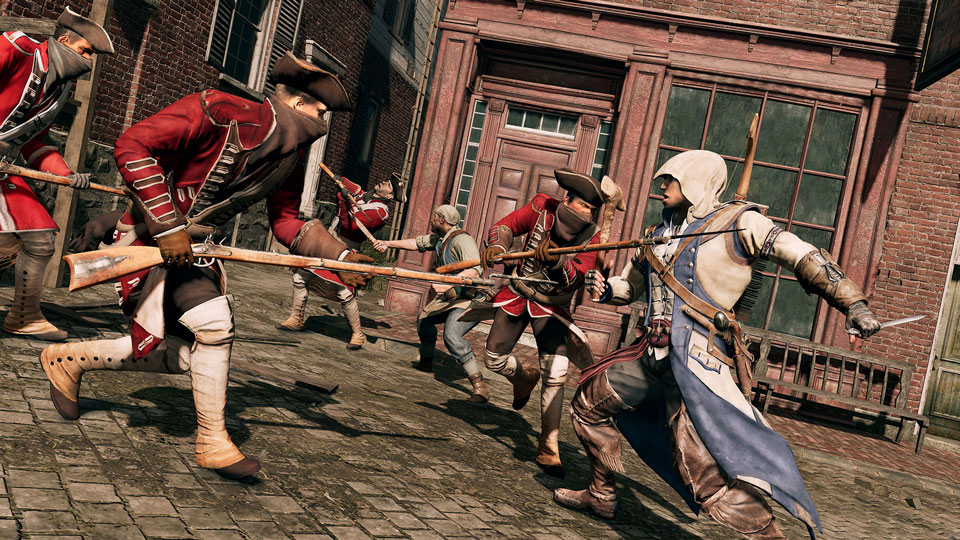
I wanted to like Assassin’s Creed III. I REALLY did. After all, it was the culmination of the story Ubisoft had begun telling five years previously, a mission to save the world from total destruction, and an opportunity to revisit one of the most significant time periods in the United States’ history. And it came so, so close to being good.
Released in 2012, this game feels as old as it is. There are numerous graphical glitches, animation errors, framerate drops, and texture pop-ins. Navigation is awkward and combat feels too bulky, unlike the smooth and free-flowing movements Assassins are supposed to make. The majority of missions drag on, following the same rigid flow of gathering information, finding, and then assassinating your target. As well, Connor is, unfortunately, not as compelling of a protagonist. Much of the story happens around him and in spite of him, making him feel more like a glorified errand boy than anything else.
By an order of magnitude higher, the best addition this game brought to the series was the inclusion of ships. Naval combat is immensely fun, and this would eventually be the primary mechanic in a game of its own. In addition, AC3 introduces a more robust crafting system, dual-wielding weapons, and a dynamic weather system, which are all welcome, but this entry does not live up to the high standards of the franchise.
12. Assassin’s Creed: Syndicate
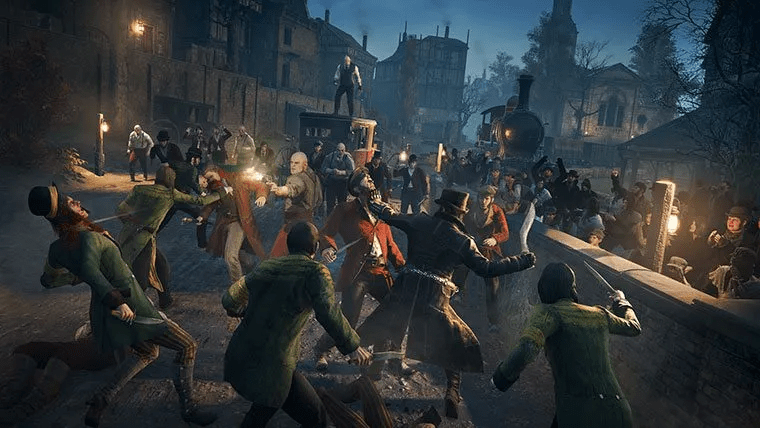
I feel like maybe I missed something when I played Syndicate a few years ago, instead of immediately following its 2015 release.
Maybe I didn’t fully appreciate the different skills and dynamics of the Frye twins, who’s personalities were one-note and followed the “patient sister/aggressive brother” trope to an almost painful degree. Maybe I didn’t fully understand the plot, in which the Fryes’ motivations is to build their own gang which ran almost-counter to their Assassin beliefs. Maybe I didn’t enjoy the repetitive side missions, or the strange semi-lighthearted tone the game tries to adopt.
What I do know is that Victorian London was fascinating to explore, the grappling hook revitalized the traversal system, and the assassination missions themselves stood out because of unique, context-sensitive kills the player could. The inclusion of the Time Anomaly and being able to jump time periods AGAIN and into London’s “future” during the 1940s was also a fun piece of side content that further expanded what Assassin’s Creed could be. Taking London back, ultimately, was not as fun as it could or should have been. I think part of what it comes to is memorability and personal impact, and Syndicate just didn’t have one on me.
11. Assassin’s Creed

While the original has to be heralded for being the starting point of a long-lasting franchise, this game has aged the worst among all its counterparts and sequels.
I accuse the above entries as having repetitive missions and clunky combat, but having been released in 2007, Assassin’s Creed had many leaps and bounds to make before becoming the memorable series it is. The investigation events are limited and lackluster, the flag collectibles are a PAIN to all find, and the characters, both in the past or the present, are neither engaging, nor have any depth of personality or range of emotion.
Some would argue that the parallel storyline reveal should not have been made at the beginning, but I think it sets up the “virtual” nature of the game’s world and gives players an additional motivation beyond hunting down Templars. Although Altaïr was not a particularly captivating protagonist, the world and situation we found ourselves thrust into was more than enough to compensate. It’s plodding pace and monotonous mission structure, however, drag this game down to feeling more like a tech demo than a fully-realized adventure.
10. Assassin’s Creed: Rogue
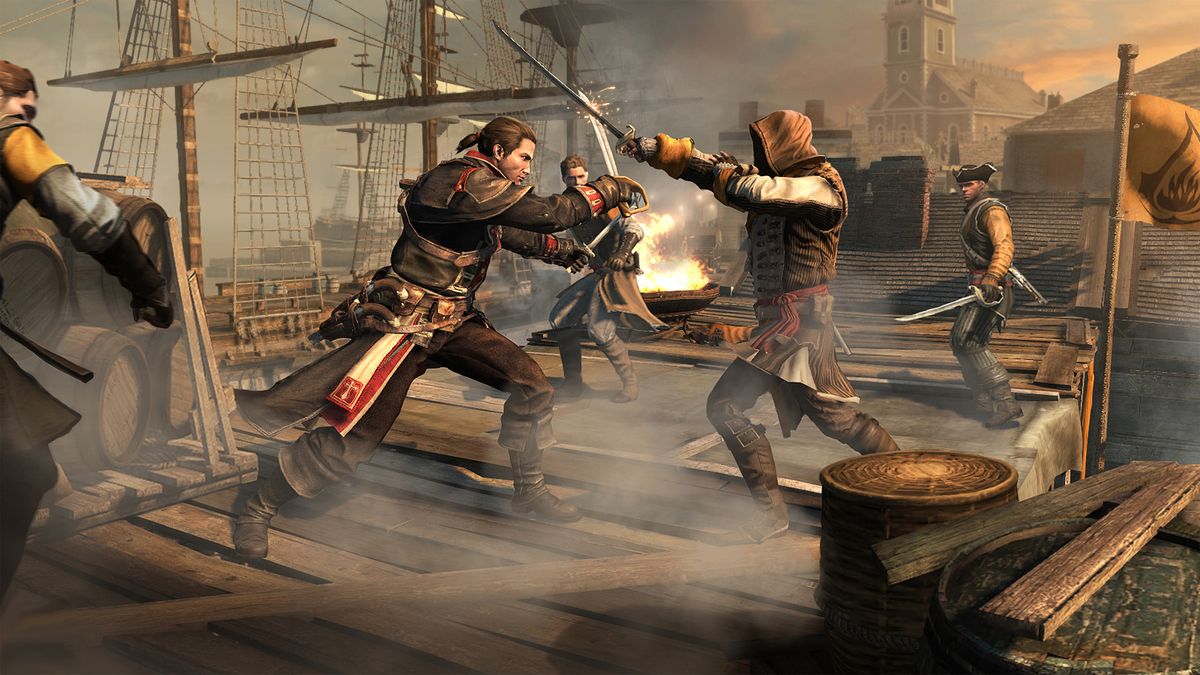
I’m just going to put it out there: Rogue suffers from all the same problems as the above games, maybe even worse-so. It feels generic, the gameplay loop is repetitive, and the few additions are quality-of-life improvements to the missions. So why is it much higher on the list? Its story.
Rogue brings in an ambiguity that every entry before and since has been missing. The player takes control of an Assassin who becomes disillusioned and estranged from his cause by compatriots who were willing to put innocents’ lives at risk to further their own goals. As a result, he joins the Templar Order in order to prevent the Assassins from destabilizing the world.
However, this does not save the game from being far too short, having too little side content, and too little incentive to explore the North Atlantic. Ultimately, Rogue comes off feeling more like an expansion than its own fully-fledged game. There isn’t a whole lot more else to say about this entry, so just like when I played it, I won’t devote a lot more time to it.
9. Assassin’s Creed: Valhalla
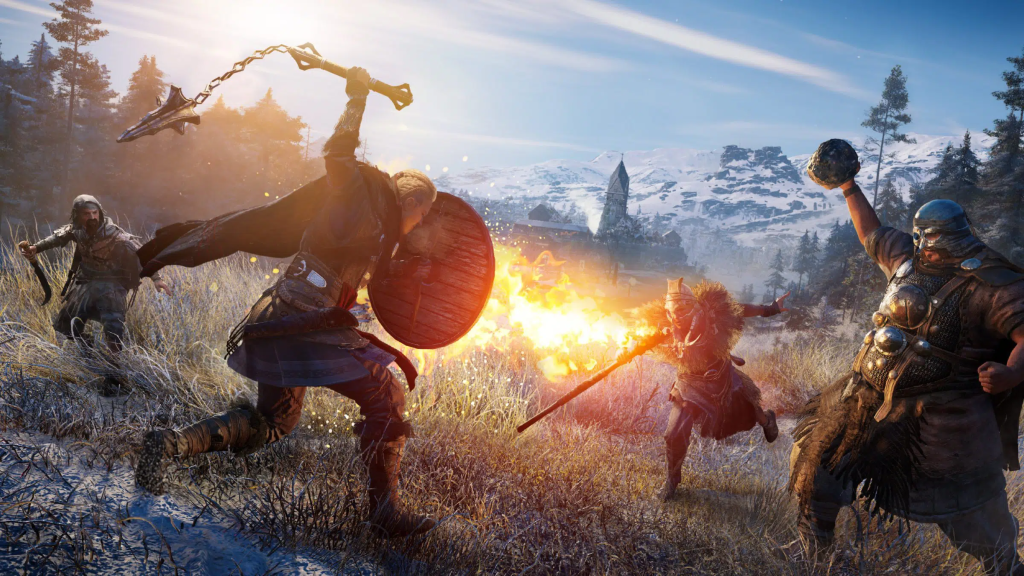
By the time it was released in 2020, Valhalla was supposed to be the culmination of every lesson Ubisoft has learned during the 15 years the franchise has existed. In the end, though, being a Viking raider wasn’t all it was cracked up to be.
I’ll just get the fact out of the way that the game is incredibly buggy, even still after two years. I know in this day and age, games can be patched way after release, but this still feels like an unfinished product in some places. While the game’s map is among the largest in the series, many other factors feel condensed. There are fewer gear options as compared to the other games following the franchise’s new action-RPG direction, traversal and travel become chores, and the few choices I can make in the game’s story don’t feel like they make much impact.
However, as a Viking, combat is exceptionally fun and particularly gory, and the raiding missions allow me to live out my fantasy as a raider. In addition, it was enjoyable to build up Ravensthorpe, deciding which upgrades to choose and how to make my town flourish. Not to mention, the segments where I could actually explore Asgard were some of the most fun in the entire game, getting to explore this strange and mythical realm. But compared to the other games following this new style, Valhalla doesn’t quite reach the heights as its predecessors.
8. Assassin’s Creed: Mirage

Mirage was envisioned as a return to the series’ roots, with a greater focus on stealth and assassination mechanics, in addition to returning to the Middle Eastern setting. In its execution, while some of these changes are welcome, the entry doesn’t satisfy my yearnings the same way as other entries do.
Maybe it’s the reworked combat, where the player can only take a few hits as opposed to the heavy tanking that other protagonists can handle. It could also be the total length of the story and side content. Sure, you’re paying less for the game in the end, which is a positive, but I want to be able to sink time into a title and really lose myself in it. What it comes down to is the sense of scale. Everything feels smaller, pared down; the bloat of something like Valhalla has been removed, for something more in-line with the very first entry in the series.
With this renewed attention to assassinations, however, come the more detailed investigations and numerous approaches to taking down your target. You have to find and even create the opportunities you will utilize in order to become a master killer. It requires planning, foresight, and a little creativity, which does play into the assassin fantasy the series has shifted away from. It may not be the most impactful, narratively or ludically, but for its value, it packs a punch.
7. Assassin’s Creed: Revelations
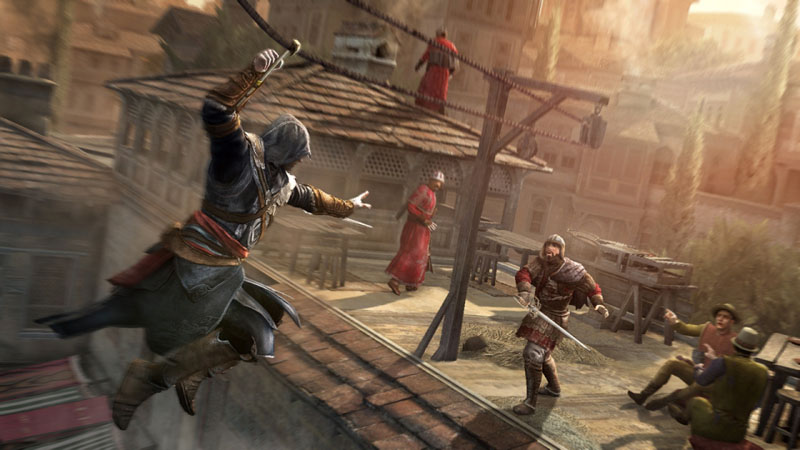
The end of an era. Ezio’s journey comes to an end where our journey as Assassins began: in the footsteps of Altaïr.
Revelations brings our loveable Italian protagonist to Constantinople as he tries to enter the Master Assassin’s hidden library beneath the fortress of Masyaf. In some ways, it’s a fitting end to Ezio’s story, as he comes to terms with his role in history’s grand plot. We get to see how his and Altaïr’s stories intersect and parallel as we explore the unfamiliar territory of Ottoman Istanbul, introduced to ziplines for the first time in the series and a unique bomb-crafting mechanic.
However, looking past our love for the main character, the game’s shortcomings become easily apparent. The Desmond/Lost Archive missions are aesthetically pleasing, but ultimately filler. The aforementioned bomb crafting has potential, but is needlessly complicated and unnecessary. The lack of side content leaves me particularly wanting, with extremely few tombs or dungeons to explore, challenging missions to overcome, or anything new and engaging. Revelations does reveal much to us about Desmond’s journey, but it feels more like a small step as compared to the previous entries.
6. Assassin’s Creed: Unity
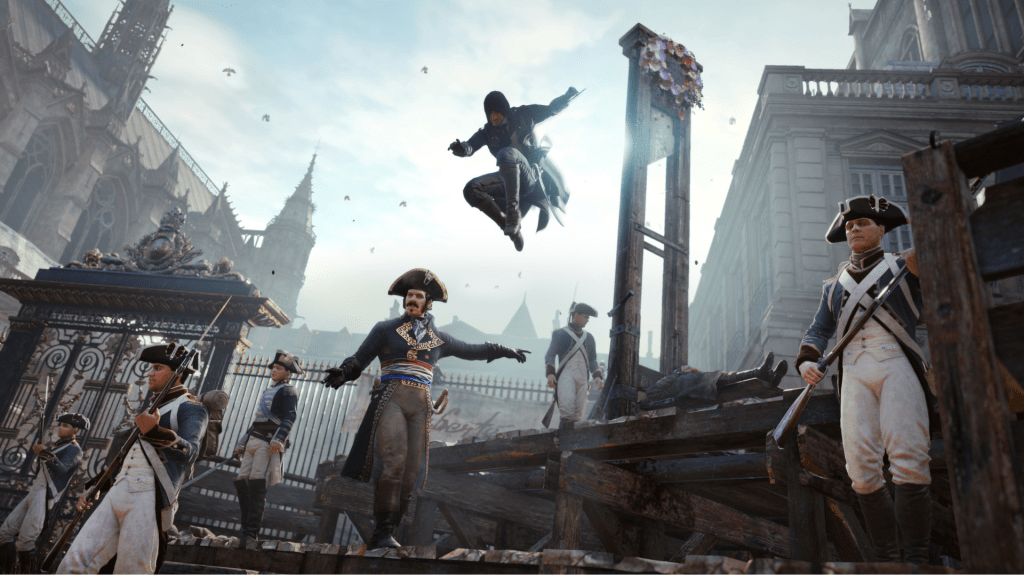
At the time of its release, it’s hard to imagine Unity would be remembered as one of the better entries in the series, but looking back, it was a real revolution.
Originally an extremely buggy mess, with complaints ranging from major graphical errors to connection issues on multiplayer cooperative missions, Unity is now fondly remembered for all of the major changes the series has now made to its current direction. This is the first game in the series to move from action-adventure to action-RPG. Players now can obtain gear to improve different stats beyond just an increase in health, and there’s a leveling system that allows independently improve your melee, ranged, and stealth capabilities. Freerunning was also adjusted to give the player more control of moving downward as well as upward, providing new parkour opportunities. There are also murder mysteries for the player to solve, each with clues to find, suspects to interrogate, and criminals to imprison.
While I love the idea of the coop missions, that means a significant portion of the content is locked out to people who don’t want to pay monthly for multiplayer services they only occasionally use, leaving some of the most fun parts of the game gated from entry. Regardless, this is something which remains in the series to this day. Not to mention the numerous controversies that plagued it, including the previously-mentioned technical issues, criticism by the French government for its depiction of the French Revolution, and deliberate exclusion of playable female characters in the multiplayer. Despite all this, in the end, I can’t help but think about everything Unity did to enliven and modernize the franchise in this engaging new direction.
5. Assassin’s Creed: Origins
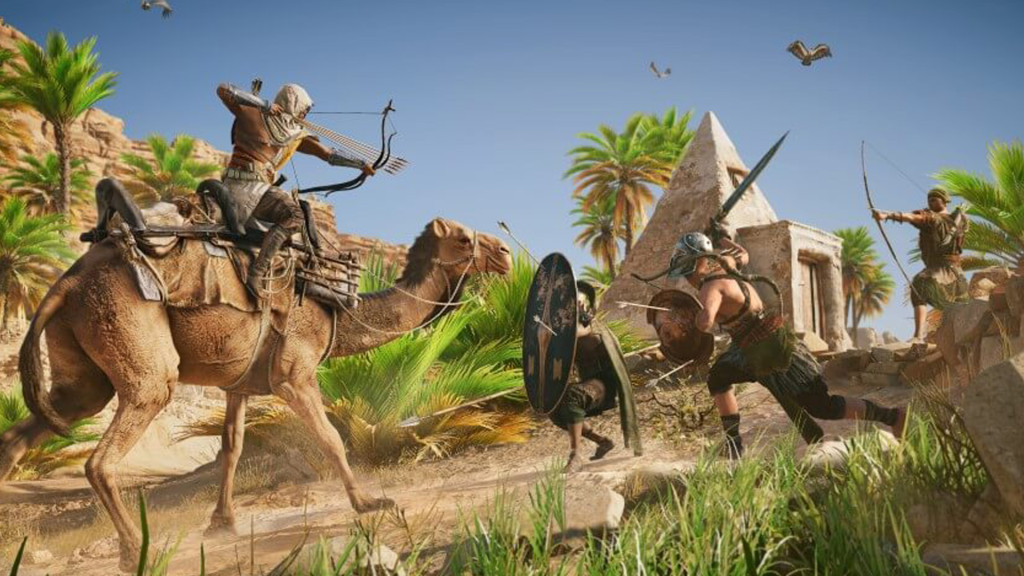
Whereas Unity takes the first step toward the series’ current place, Origins takes the largest leap from its predecessors, redefining the franchise to its current place.
Although not the first action-RPG in the franchise, Origins overhauls many of the core mechanics. The combat has been revamped to be much more fluid and dynamic, with new abilities and tactics available to the player. With the plethora of weapons, you had numerous playstyles you could select, and they would all be valid. Your Eagle Vision has been replaced by an actual eagle that can mark and even distract targets. Unity may have leaned slightly into the RPG elements, but Origin embraces it fully. Plus, Egypt was one of the most amazing settings to explore yet. Each region felt unique, with different architecture and environments to explore.
Moving away from more stealthy elements does greatly change what it means to be an “assassin,” however, so while the new freedom to complete missions as you see fit is welcome, it’s a divisive choice. Unfortunately, the game also feels purposely padded out at times, with artificial level barriers in place to force players either to grind their level up or purchase a boost from the game store. I love being able to soak time into a game, but not because it’s been extended by developers or publishers looking to make an extra buck. It feels more like an MMORPG at that point, and I want to avoid that kind of play-cycle. Origins deals with the founding of the Hidden Ones, later to be known as the Assassins, and this game marks the start of a new course for the series.
4. Assassin’s Creed II

Before sitting down to write this, I never made this connection before: Assassin’s Creed II is about and is the birth of a new era. It’s funny. Not only does this game take place during the Italian Renaissance, a period of significant change in the world and ushering out the Dark Ages, but with this game, Ubisoft was able to capture what people loved about the first game and run with it.
Everything we knew from the first game has been exponentially expanded upon. Now, there are shops and items to buy, different weapons and armors to equip, two hidden blades to wield in new ways. Renaissance Italy is a beautiful environment to explore. Ezio is infinitely more charismatic than Altaïr. The conspiratorial plot uncovered over the course of the game unravels everything we thought we knew about the world. I could go on and on.
This game definitely feels its age, though. The parkour and freerunning can be janky at times, and the mission design hasn’t quite reached its pinnacle. But with one-off inclusions like da Vinci’s flying machine or infiltrating the Vatican, the memorable moments more than make up for these deficiencies. AC2 set the high standard that the rest of the series would come to be known by from that point further, redefining what being an Assassin meant.
3. Assassin’s Creed IV: Black Flag

Pirates. Need I say more?
Fine.
While Assassin’s Creed III was the entry to introduce the naval battle mechanics, it isn’t until the next entry, Black Flag, where we see the best concept of AC3 fully realized as its own game. Exploring the Caribbean Sea, boarding enemy ships to duel captains, and befriending pirate legends like Blackbeard and Charles Kidd is exhilarating. It’s almost like a 3D realization of Sid Meier’s Pirates!, one of my all-time favorite games. From digging up buried treasure to assaulting forts single-handedly, Black Flag fully lets you live out your pirate fantasy and investigate every little island you come across.
Edward Kenway is the series’ first antihero protagonist, bringing himself into the Assassin/Templar conflict for selfish reasons and forced to correct his mistakes. Alongside him, we learn and grow and come to understand that a man cannot be an island, and cannot look out for himself and short-term gains alone. Seeing as this runs counter to the personal philosophies of piracy, Edward learns how to navigate this cognitive dissonance as he sails across the sea, and we join him in that journey. It isn’t long before you find yourself humming along with crew singing shanties.
2. Assassin’s Creed: Odyssey

This might be somewhat of a controversial pick, given how much the series has deviated from its roots, but Odyssey managed to be one of the most fun open-world action-RPGs I’ve played in a while.
Building off what Origins began with, Odyssey is an expansion on every concept. There are plenty of different gear and build options, along with the inclusion of saving presets, allowing you to switch playstyles on the fly, from stealthy to full-on combat. Exploring the Peloponnese doesn’t feel exhausting, with the numerous fun distractions, like fighting in an arena of champions, hunting beasts and mythical creatures, and exploring long-lost tombs. The story is one of, if not the, most involved yet, providing the player with choices that will affect their experience. Even choosing your character’s gender has consequences.
One of the major complaints about the series’ new direction is the inclusion of the more mythical elements, like fighting cyclopes and gorgons, straying away from the historicity that the games had spent so long situating. To which I say: the first game in the series reveals that a precursor race created humanity and controlled them with various artifacts, a global war is being fought in secret over the course of thousands of years, and a company has built a machine that allows them to relieve ancestors’ memories. Total realism has never been at center of Assassin’s Creed, and that’s okay. Odyssey strayed from the franchise’s roots, but it’s such a great game that it more than makes up for it.
1. Assassin’s Creed: Brotherhood
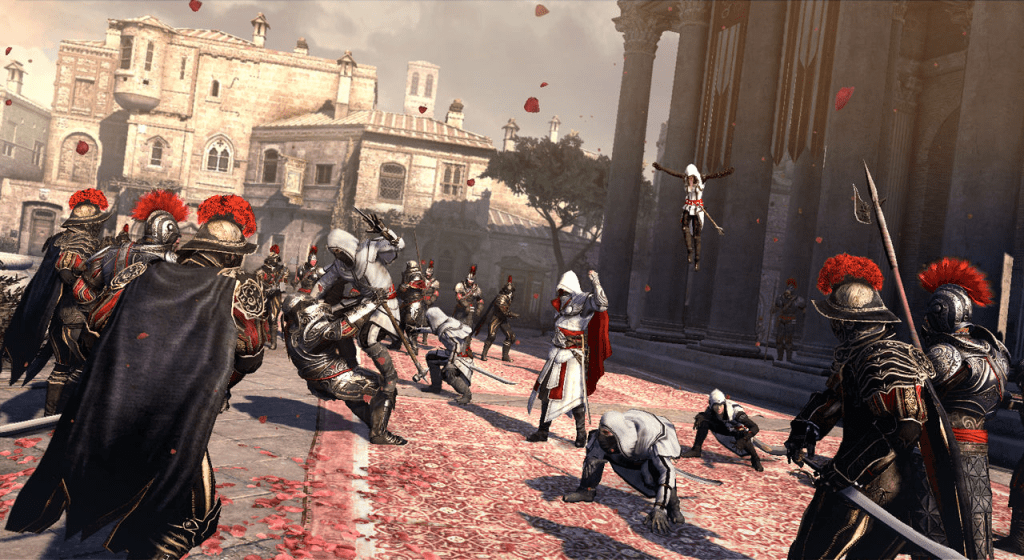
“Laa shay’a waqi’un moutlaq bale kouloun moumkine. The wisdom of our Creed is revealed through these words. We work in the dark, to serve the light. We are Assassins.” This is the promise of Brotherhood.
Everything AC2 took, Brotherhood ran with. Everything has been expanded upon and fine-tuned. The combat is more fluid than ever, with a wide variety of tactics and combo kills with the new sub-weapon system at your disposal. Rome is a rich and fascinating city to explore, with plenty of secrets to uncover in the forms of Lairs of Romulus, da Vinci’s War Machines, Templar agents, and guild missions. One of the biggest additions, however, is the inclusion of Full Synchronization. These additional challenges, whether to complete a mission in a certain amount of time or taking no damage, bring a new component to how you complete a level. While some of them can be exceedingly difficult to the point of being unfair, for the most part, they are fun little tasks to solve and overcome.
Another major inclusion to the series with Brotherhood is multiplayer. Using the Animus to train Templars against Assassins, players are assigned to hunt down targets, while they themselves are hunted, all while completing different game modes. It’s a fresh take on competitive multiplayer, as the most bold and quickest person isn’t the one who is rewarded, but the one who utilizes the full skills of a Master Assassin to accomplish their mission.
Brotherhood adds a new level of depth to the series, taking everything that was already great about AC2, improving upon it greatly, and bringing the franchise to the peak of its quality.
 LAFworks
One thought on “[UPDATED] Ranking Assassin’s Creed”