My introduction to the Persona series was a little unusual. Before playing any of the games, before seeing the anime, I was part of a tabletop RPG group that made a custom Persona campaign. Each player juggled academic and social life during half the session, and the other half was dedicated to fighting massive spirits and unraveling a conspiracy. The concept intrigued me, to say the least, to the point where I temporarily took over writing the story for the campaign. That’s when I really began to be immersed in the franchise, discovering rhythm games and popular parody comics. Although Persona 3 was the first game in the series I witnessed, P4 was more current at the time, so that became my main entry point. It wouldn’t be until years later, however, that I would actually play the game, once the enhanced Persona 4 Golden was released on Steam.

After being sent to the rural town of Inaba while his parents are working abroad, the unnamed protagonist (canonically known as Yu Narukami) becomes wrapped up in a series of murders plaguing the area. All the while, a mysterious television channel that only appears on rainy nights. The player and his friends soon learn they can hop into the TV World, battling shadowy figures and overcoming deep, repressed internal struggles, eventually manifesting their self-realization into the eponymous Personas. Along with a growing cast of characters, the player investigates disappearances all related to the murders, discover the truth, and eventually save the world from destruction. You know, typical high school fare.
Atlus really goes all-out for their rereleases. When I say, “enhanced port,” I don’t just mean some graphical changes, maybe some new difficulty levels. I’m talking all that AND more. I’m talking new social links, multiple endings, a secret final dungeon, new events, new voice actors, fast travel, new music, online mechanics, a completely revamped battle system, and additional bonus content outside of the main game. Seriously, it’s so much, it might as well be a new game entirely. Speaking of, I probably should go back and replay the original P4, once I find my break out my PlayStation 2. The experience is bound to be different, and I’m looking forward to comparing equivalent scenes from each part.

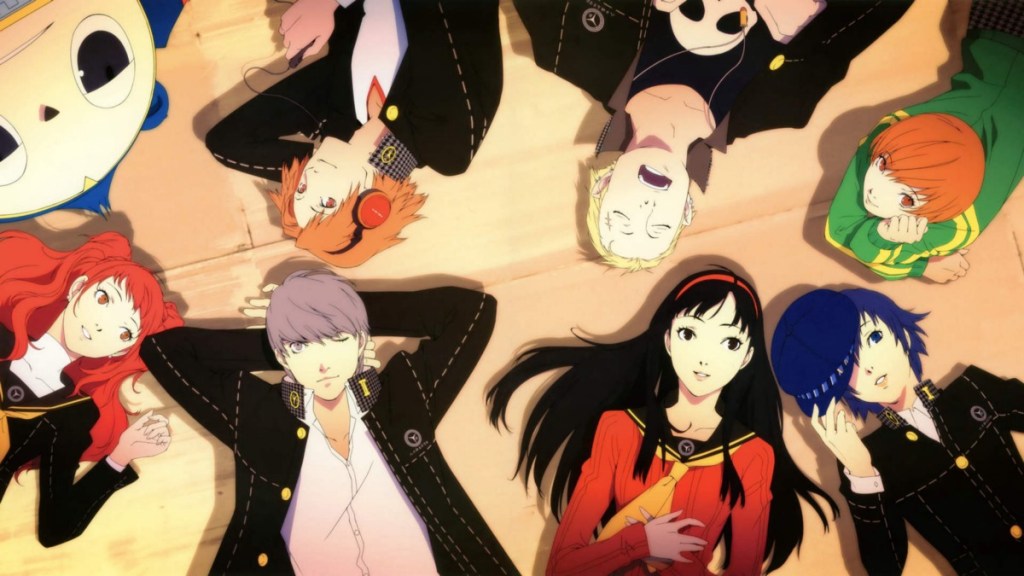
While I was first introduced to the cast through the above-mentioned Hiimdaisy comics, I didn’t really get to appreciate them until my playthrough of the game. Some characters come across just fine. Chie Satonaka or Nanako Dojima, while dynamic in their own right, can be caricaturized without losing much. Others, like Ai Ebihara or Marie, have a level of complexity to them that can only be fully delved through an actual playthrough of the game. My personal favorite is Kanji Tatsumi, voiced by the incredible Troy Baker. (Story time: my first encounter with the voice actor was actually in Mass Effect 3, where he played the one-dimensional and quite-possibly worst character in the franchise, Kai Leng. Because of how much I hated the character, I thought I wouldn’t be able to stand anyone else Baker played. Boy, was I wrong.) There are a total of 23 social links for you to explore, meaning hundreds of individual character interactions and events for you to explore. And these aren’t just for character development; deepening your social link will unlock new talents and abilities for you and your party. Completing all of these is impossible to do blind, or potentially even on a single playthrough, but if you’re a JRPG fan like myself, then it’s also impossible to not at least attempt it.
Speaking of, you will likely need at least one guide to make it through the game. The Shin Megami Tensei series has been notorious for its difficulty, and the Persona games are no different. This goes beyond the social links. You need to learn how to balance interacting with other characters, exploring Inaba, attending school, and completing dungeons in the TV World. You need to increase your own social stats to unlock certain character interactions and content. You need to know which Personas are compatible and what bonuses each day brings when fusing them to create even more powerful Personas. You need to balance the strengths and weakness of your party, compensate with the lineup of your own Personas, and consider whether it’s a good idea to use that health potion and make it to the next level or go home and try again another day. It can be a lot to handle, to say the least.

Gameplay itself is what you can typically expect from a JRPG. Each character has a different class, and with it, different abilities. When exploring the dungeons, each designed around the kidnapping victim you’re attempting to rescue, you can collect items and encounter enemies. The player and enemies take turns hitting one another or slinging spells until one is declared the winner. Unless you’re a fan of this kind of gameplay, most will believe it unengaging and even boring. However, I find it strategic, taking the time to consider my enemies’ weaknesses before knocking them all down to perform an All-Out Attack. Something Persona does differently than other RPGs is allowing you to set tactics for the party, letting the AI control their moves, as well as being able to speed through combat via a fast-forward mechanic. It may seem cheap at first, to be granted an ability to skip the majority of gameplay interaction, but when farming lower-level dungeons or when trying to power through to the end, being able to quickly push through combat can be quite helpful. At the end of each combat comes Shuffle Time, where players pick from a set of cards to determine bonuses, including increased experience, gold, or even a new Persona to use. Sometimes, this mechanic became easy to exploit, whereas at other times, it felt as though the game were trying to purposely screw me over.
This is a phrase I might end up repeating, but this game just oozes style and personality. The graphical style of the original game really took advantage of the PlayStation 2 hardware, and it looks even better now in full HD resolution. Even the GUI is stylized and suits the aesthetic tone the game is building throughout. More so than these, however, the soundtrack stands out as particularly phenomenal. Every track is memorable in its own right, whether groovy and upbeat, or tense and dramatic, or invigorating and exciting. Before long, I found myself bobbing my head and even singing along with “Heartbeat, Heartbreak” and “Reach Out To The Truth.” Just hearing the titles of these songs don’t do them justice, give them a listen for yourself. You can blame me if they get stuck in your head like they have with mine.

To date, Persona 4 consistently ranks among the greatest games of all time, and it’s easy to see why, with a dynamic battle system, catchy soundtrack, loveable cast of characters, stylish art design, and poignant exploration of narrative themes. Playing it after all that time made me realize I had spent years missing out on this fun RPG, a mistake I know I won’t be making again. Although not my favorite JRPG (Final Fantasy IX takes that spot without question), nor even my favorite Persona game (more on that later), Persona 4 Golden has helped to set a bar for the types of games I find myself preferring more and more: ones hundreds of hours long, with an emphasis on character interaction and tactical gameplay. Hopefully that 100+ hour gametime doesn’t scare away any potential players, because while it does take a healthy chunk of time between starting up a new file and really being able to freely explore the game, it’s a wait that’s worth while.
This is part one of three entries for the Persona franchise I am completing. Next up is a double-feature on the latest mainline release in the series along with its own enhanced port. Dedicate enough time to it all, like I have, and these games will Take Your Heart.
 LAFworks