Dungeon crawlers and roguelites are a particularly favorite genre of mine, behind anything RPG, and that’s because of their near-infinite replayability. With procedurally generated maps, randomized enemies, benefits that disappear upon dying, and piece after piece of epic gear to loot, some of these games can last the test of time. I find myself going back to Diablo III (less so after the uncovering of Activision-Blizzard’s legal and ethical problems) or The Binding of Isaac every now and then. Hell, Diablo II was released over 20 years ago, and it still has a base of passionate players keeping it going and exploring the corners of Sanctuary. Speaking of hell, however, there’s another game which my friend turned me onto, involving traversing the depths of the underworld and fighting champion enemies. Little did I realize, however, that Hades would become one of my favorite games of the last few years.

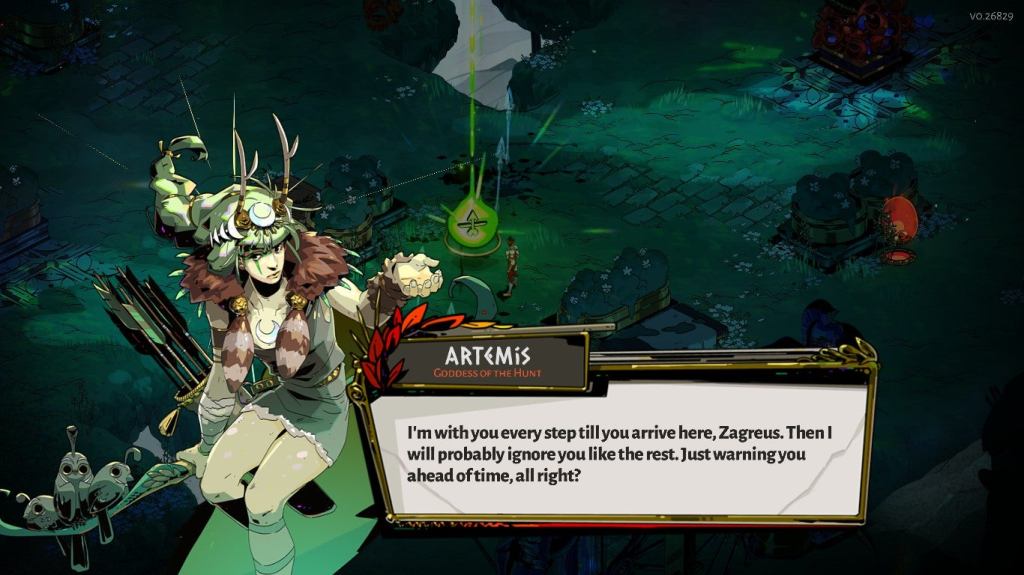
As Zagreus, the Prince of the Underworld, you’re tasked with two responsibilities: maintaining your family’s household, and trying to escape to the surface. After learning the truth about his birth, Zagreus makes it his mission to break out from the Underworld to find his birth mother, living somewhere in Greece. The only thing that’s stopping him are the armies of the dead, waiting to send him home. Assisting him are the Gods of Olympus, who believe Zagreus is trying to flee to their haven. You’ll hear from Athena, Poseidon, Aphrodite, and Hermes, just to name a few. Also along the way, Zagreus builds bonds with the many servants of his palace and denizens of the Underworld. It’s hard to whittle down the cast to determine my favorites, but ones that particularly stood out to me were Achilles, Megaera, Sisyphus, Dusa, Eurydice, and Skelly.
Each room of the various levels of the Underworld (Tartarus, Asphodel, Elysium, and Styx) are built as a constantly-shifting labyrinth, preventing anyone from attempting to escape. I like how the developers created an in-game reason for the rooms to be randomly generated; that’s attention to ludonarratology. Because Zagreus is a God, death is only a minor inconvenience, sending him back to the palace. Every attempt allows for new combinations of active and passive abilities, leading to seemingly limitless options with which you can approach the souls of the dead. You might find a Daedalus Hammer that alters your weapon’s attack, boons from the Olympians, darkness and gemstones, or encounter a level-specific NPC who will provide you with a special item of your choice. Add onto that the Pact of Punishment, which lets you customize your escape attempts even further with new challenges, and it won’t be long before you’ve sunk hours into aiding Zagreus on his mission.

Speaking of weapons, you only get to choose one for your entire run, but you can switch between six unique weapons, which each have four Aspects (three normal, one secret), giving you a total of 24 different playstyles to choose from. Each weapon itself handles differently, with some attacking faster while others are more powerful per strike. Sometimes you’ll want to fight enemies up and close, or other times, you might want to pick them off from afar. Every weapon and aspect is viable, so you can figure out the ones that work best for you. My favorites for each weapon are the Aspect of Chaos for the Shield of Chaos, the Aspect of Lucifer for the Adamant Rail, the Aspect of Rama for the Heart-Seeking Bow, the Aspect of Achilles for the Eternal Spear, the Aspect of Talos for the Twin Fists, and the Aspect of Arthur for the Stygian Blade. Whether you want to pick one of the higher-tiered weapons or experiment with a new style, there’s plenty to pick from.
I just love this game, flat out. Everything has been finely crafted and detailed to create a tidy, charming, difficult, and heartwarming game. The writing is phenomenal, to say the least. Every character feels unique, with their own personalities, backgrounds, and motivations. The dialogue is entirely contextual, too. Depending on what weapon you’re using, what trinket you’re wearing, whether a certain enemy killed you on the previous run, each character will have something unique to say. I don’t even think I’ve seen any repeated lines, except for when I started a new file. You may end up liking some characters more than others, but even the hated ones are ones we love to hate. You’ll see what I mean when you get to Elysium. Along with the writing, the voice acting is fantastic as well, bringing each character even further to life. Whether hearing the sorrow in Orpheus’ ballads or the disapproving tone of your father Hades, it really does feel like every character brings something different to the table. No one feels ancillary, even ones hanging out in the background, because you’re always interacting with them, running errands or helping them out with something. Developing deeper relationships with the cast isn’t just for the benefit of storytelling, either. Each character will give you a little trinket which aids you during your run, and you may even find some pets to join you along the way. Neatly wrapping it all together is a gorgeous soundtrack. Each song brings different emotions with it, whether the excitement of battle or the calm of a respite. I often found myself just standing around the levels and listening to the music, especially in Eurydice’s chamber. Seriously, anyone who doesn’t sit through “Good Riddance” is committing impiety.
None of this is to say that your escape from the Underworld will be easy. On the contrary, this game starts off extremely challenging before you learn enemy attack patterns, how your weapons work, what boons do what, etc. It took me almost 20 attempts just to beat Megaera and advance from Tartarus to the next level. After that, however, the difficulty curve gets really wonky. I found Asphodel and the boss there, the Lernaean Bone Hydra, much easier than the previous level. I initially chalked it up to getting better at the game, but then Theseus and Asterius smacked me down from Elysium and straight back to the palace. But after completing each of these planes and making it out of the Temple of Styx, there’s one final challenge waiting for you. I don’t want to spoil any surprises, but needless to say, you will find yourself consistently surprised by it.
The message this game is trying to tell is really touching, about the importance of family and to persevere even when things seems insurmountable. I grew to care about the fates of these characters, all trying to escape what seems inescapable. And yet Zagreus persists, returning to the surface each time despite never being able to stay there permanently. It’s a lesson we can all learn something from. By the way, I can’t believe I waited this long to mention that there’s a fishing minigame, and that’s why Hades is a near-flawless masterpiece.

 LAFworks