When I left off last time, I had mentioned the third Danganronpa game I wanted to discuss was very different than the others. The first ones had elements of visual novels, but they were still undeniably games. Again, this is not the time for a debate on what constitutes a game. This conversation is actually completely irrelevant to the entry I’m about to slash through. With Ultra Despair Girls, there’s no question at all about whether this is a game.
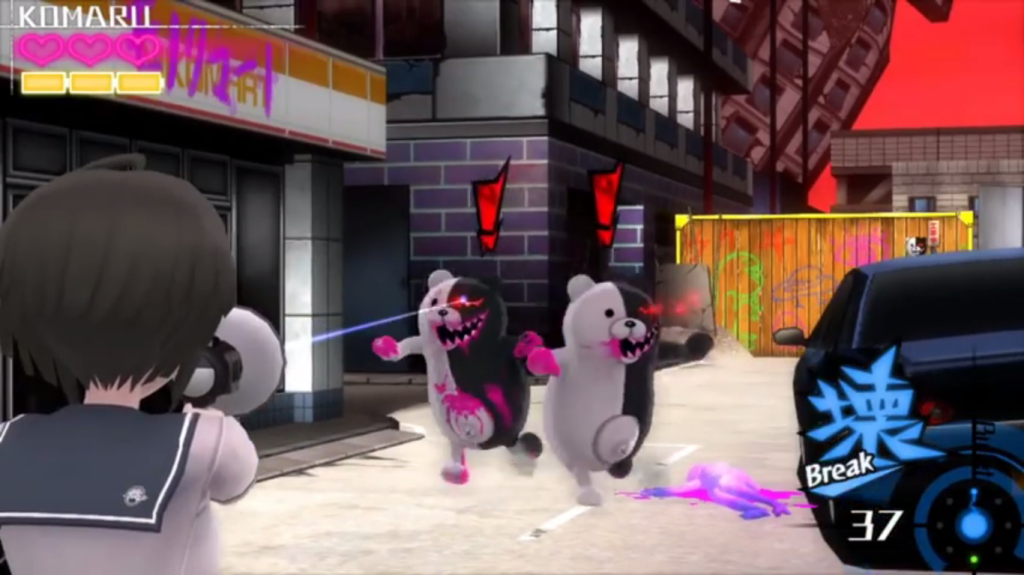
Moving away from the more linearly-driven path of the visual novel, UDG is a third-person shooter with a ton of arcade mechanics. Truth Bullets return, but they’re less of a metaphorical concept and more of an actual piece of ammunition. Players are given a hacking gun with tons of different ammo types, from your basic Break to more gimmicky ones like Paralyze or Dance. Of course, you don’t get to keep all of these powers and have to unlock them again throughout the game, but after getting a small taste of your abilities at the beginning of the game, you’ll find that each ammo type can be helpful depending on the situation. Otherwise, it’s your standard shooter fare, which is fun but a little basic at times. Although there are quite a few different enemy types, they’re all Monokumas (which can get a little boring) and they can usually be dealt with using the default Break ammo.
Other than your shooting segments, there are stealth segments which require you to find a kid without being caught, Monoku-Man arcade machines that act as security cameras for challenge rooms, and riddles to solve to progress in the level. You’ll have plenty of opportunities to not only experiment with your Truth Bullets and find ones which work best for you, but also to collect Monocoins, which are used to purchase upgrades in the form of adjectives for your guns. It’s a strange concept to wrap your head around, but combos like Furiously + Ornately can augment the ammo’s strength and total ammo count. It’s things like this which really make UDG unique, especially among shooters. What other game allows you to improve your guns with the power of language?

Without spoiling too much from the other DR games, players can also temporarily switch characters. This second character has extremely powerful melee attacks and special moves that allow them to slice through enemies like fabric, but is limited by a meter that determines how long they can be used for. It’s honestly a blast to play as this character, weaving and dicing through waves of Monokumas, and their special ability takes the form of pretty sadistic automated segments that can bring a twisted smile to your face.
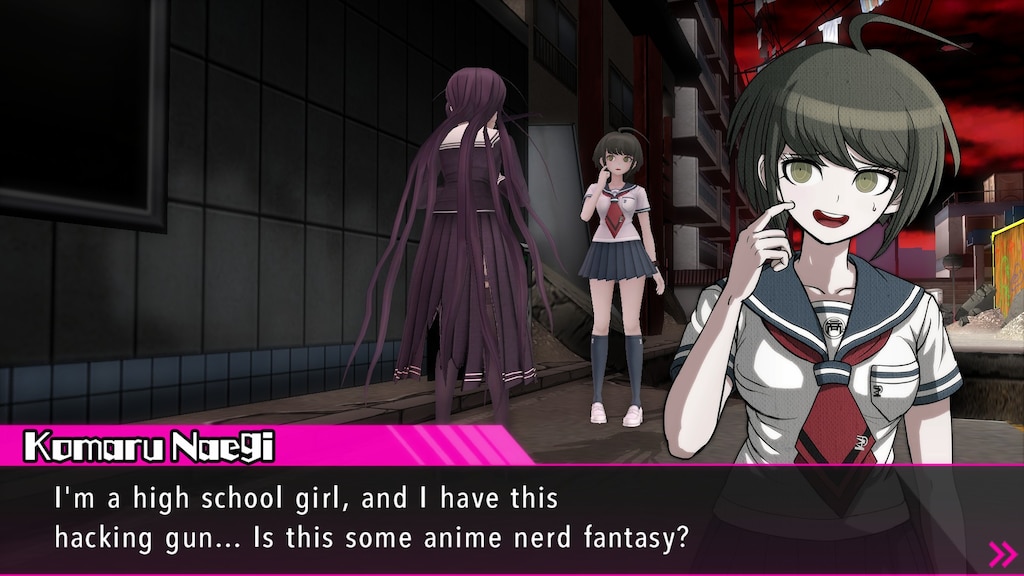
The story is a lot more personal this time around. Instead of the large cast of high schoolers slowly being picked off by each other, the narrative follows Komaru Naegi, the sister of the DR1 protagonist, who was captured and imprisoned during The Tragedy. After escaping an attack by a vicious Monokuma, she finds herself in a world far different than the one she remembers. A ruthless group of children calling themselves the Warriors of Hope have taken over the city and are killing all of the adults to create their own paradise. Working alongside her partner and DR1 veteran Toko Fukawa, the two have to destroy multitudes of Monokumas, escape the city, and defeat the Warriors of Hope.
There’s a greater focus on Komaru finding within herself that she’s more than just a normal high school girl. She and Toko are trapped in this incredibly hopeless situation, and the story follows them working together in order to overcome it and both become stronger because of their partner. It follows the same arc as the other games, with Hope overcoming Despair to save the world, but you can see real character development between Komaru and Toko. They both rise to the occasion and, despite whatever differences they may have in the beginning, they learn to become friends and partners. It really gets to expand on Toko’s character, who was only somewhat touched upon in DR1, and we get to see why Komaru is distinct from the other protagonists, Makoto and Hajime.

When I said that UDG is very different than the other DR games, I wasn’t just talking about the gameplay. The story is more personal to the protagonist than the entire cast, and because of that, there isn’t the same overall emotional impact. We don’t get a chance to develop emotional connections to many of the characters thrown through the game, but come to really understand Komaru and Toko on fundamental levels. The side characters, while all nods and winks to the cast of the mainline games, can be very forgettable beyond a few lines of dialogue. And the villains, although driven by legitimately disturbing events in their past, come off as over-the-top or outright ridiculous. I suppose that’s the kind of flair to expect in these kinds of games, but on reflection, so much of it felt different than what I experienced in the other games. I guess that’s the point, though; as a spinoff, they could include ideas that might not otherwise fit in the mainline series.
To be honest, the voice acting is probably my favorite part of the game. That may be strange, that the acting is what I enjoy most about an interactive experience, but the performances you get from some of the actors are amazing. You’ll probably get the biggest kick out of Kurokuma, the foul-mouthed and hyper-talkative Monokuma variant, who is voiced by Erin Fitzgerald. That name might not mean much on its own, but she also played Chie in Persona 4 (another game I plan on covering), as well as a handful of other characters in UDG. There’s actually a really huge crossover between Danganronpa and Persona voice actors: Cassandra Lee Morris (Aoi and Morgana), Erica Lindbeck (Kotoko and Futaba), Cherami Leigh (Komaru and Makoto), Grant George (Shuichi and Shinjiro), Johnny Yong Bosch (Hajime and Yu AND Adachi); just to name a few. It’s actually really incredible how small the voice acting community is for these kinds of games, when you really investigate it.

Going back on track, I’m not sure what else I can really say about Ultra Despair Girls. If you’re looking for a wacky yet depressing arcade shooter, your choices are either this or CarnEvil. It’s fun overall, but unless you want to get a complete understanding of the story behind Danganronpa, it’s mostly skippable. You face the same waves of enemies over and over again in slightly different configurations. If you aren’t playing on the higher difficulties, there really isn’t any strategy involved other than “don’t miss.” That’s not even mentioning that outside the development of the main characters and one or two of the villains, there isn’t a whole lot going on plot-wise other than “adults bad, kill them.”
For the most part, however, it works, and as a fan of Danganronpa, it’s a welcome addition. But I can’t help but feel that it lacks some of the charm of the main games. Maybe it’s the more concentrated cast or maybe it’s the action-driven gameplay, but some indefinable element is missing which separates this game from the others in my mind.
 LAFworks
One thought on “Danganronpa Another Episode: Ultra Despair Girls”