I remember hearing about American McGee’s Alice way back when it first came out, even though I was still a child. All I really knew about it was that it was Alice in Wonderland but dark, twisted, and so edgy, Tim Burton couldn’t handle it. And although it popped up again over a decade later, in the form of its sequel, Alice: Madness Returns, it was still just a blip on my radar. But recently, I’ve heard and read some conversations reminiscing about the games, their creative art design, and their fun take on the typical Wonderland story. Curiosity plus disposable income meant I could finally dive through the looking glass and take on these games for myself.
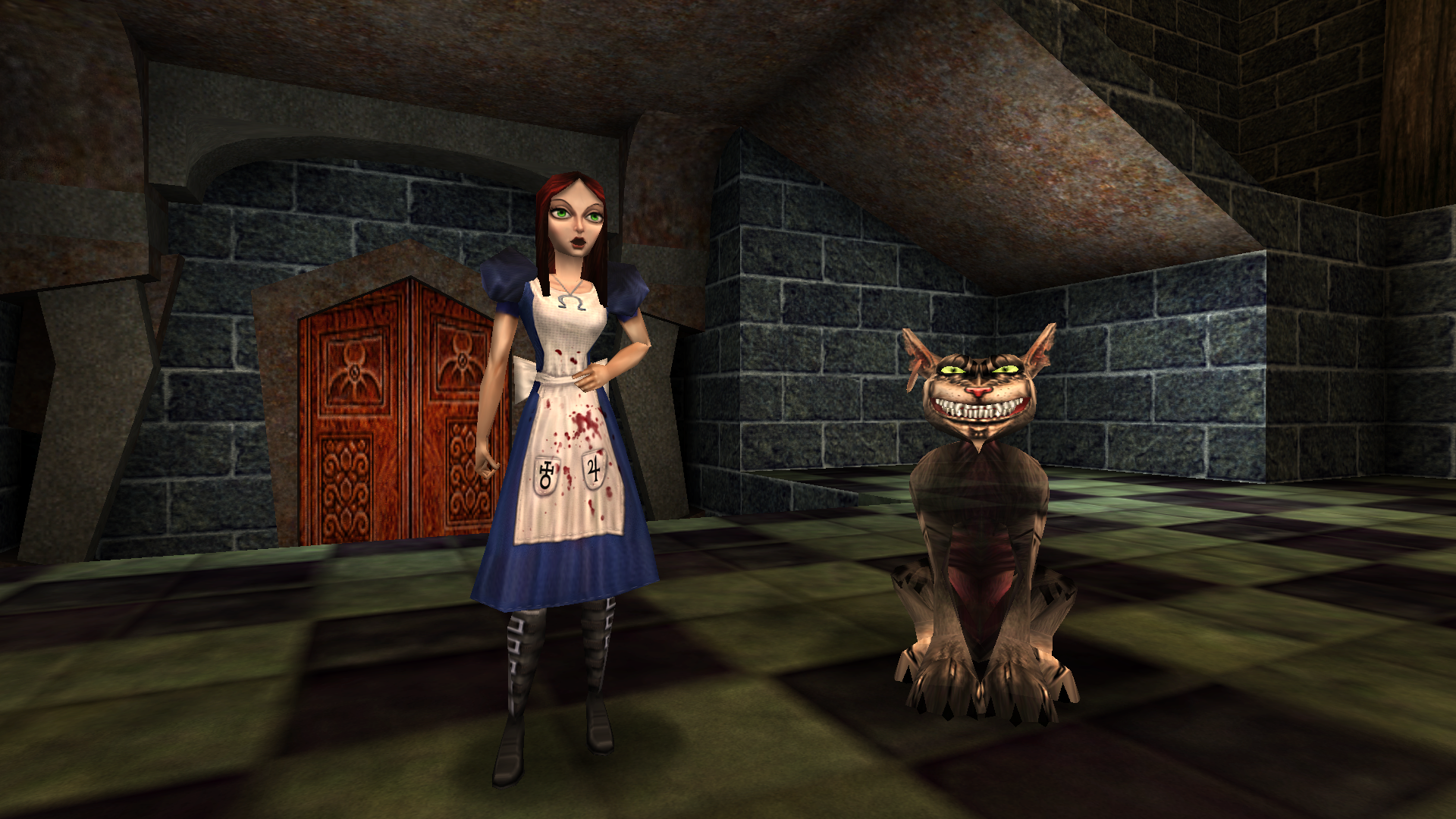
When you start the first game, Alice is a patient at a mental hospital, recovering after a fire killed her family and left her horribly burnt but alive. That went from zero to sixty quickly, from a cheery fairy tale to a deranged delve into the human psyche, but I’m for it. Wonderland has been equally decimated to reflect Alice’s state of mind, and so she has to defeat the Red Queen in order to rescue her sanity.
My first impression is: WOW, is this game difficult! I enjoy a challenge when playing a game; there needs to be a some adversity to overcome, or else the game it is too easy and not stimulating enough. I say all of this because there’s a difference making a game difficult and what you have to go through in order to beat American McGee’s Alice. First, her controls are, for lack of a better word, slippery. I played this on an Xbox 360, so my experience is different from the original PC version released in 2000, but I have to wonder if the platforming was just as difficult on a computer as on a console. Alice slides around when you so much as tilt the control stick, making it easy to just slip into a death pit. Plus, there’s a delay on the jump action! You have to remember to time each jump carefully because there’s a half-second between the button press and Alice going into the air. If there were an autosave or a quick save, this wouldn’t be terrible, but the game only autosaves at the start of each level, and you have to manually save the game each time you want to return from that point. It’s tedious, and if you’re at the end of a level, fall, and didn’t remember to save, you’ll go all the way back (I’m looking at you, Vale of Tears). I know it’s a convention of older games, but a lot of it feels like it’s there to waste time.

All of that said, I would prefer to have these issues over extremely challenging combat…but this game has both! I played on normal difficulty, and I was clenching my teeth in rage at points. Even the game’s earliest enemies can swarm and kill you in just a few hits, while they can just soak up the damage without so much as getting a scratch. Avoid using melee weapons under any circumstances, too, because your swing has no reach and has a ridiculously long recovery time, meaning enemies can get three or more hits in by the time you get one. The ranged weapons were nice, but quickly running out of willpower means you’ll be sprinting circles around enemies, stabbing their ankles with the Vorpal Blade, just enough to get a meta-substance and recover your magic so you can return to throwing playing cards or jacks. Most of the weapons are stylized as “toys,” so that justifies writing such a ridiculous sentence.
The art design, as I stated earlier, is the most intriguing element. Everything, from Wonderland itself to its inhabitants, is creepily stylized. Some of the levels, like the Village of the Doomed at the beginning or the Valley of Fire and Brimstone toward the middle feel unimaginative, but the Pale Realm and Queen of Hearts Land help set the mood and immerse you in the strange worlds of Alice’s mind. Wonderland is twisted to represent Alice’s broken state of mind, and it shows in the character and level designs. The Cheshire Cat was a notable favorite of mine, with his hoop earring, and the tentacles and corrupted flesh of the Red Queen were sufficiently unnerving. Unfortunately, the game grinds to a halt toward the end, with backtracking puzzles and multi-story mazes, detracting from the building excitement to the conclusion.

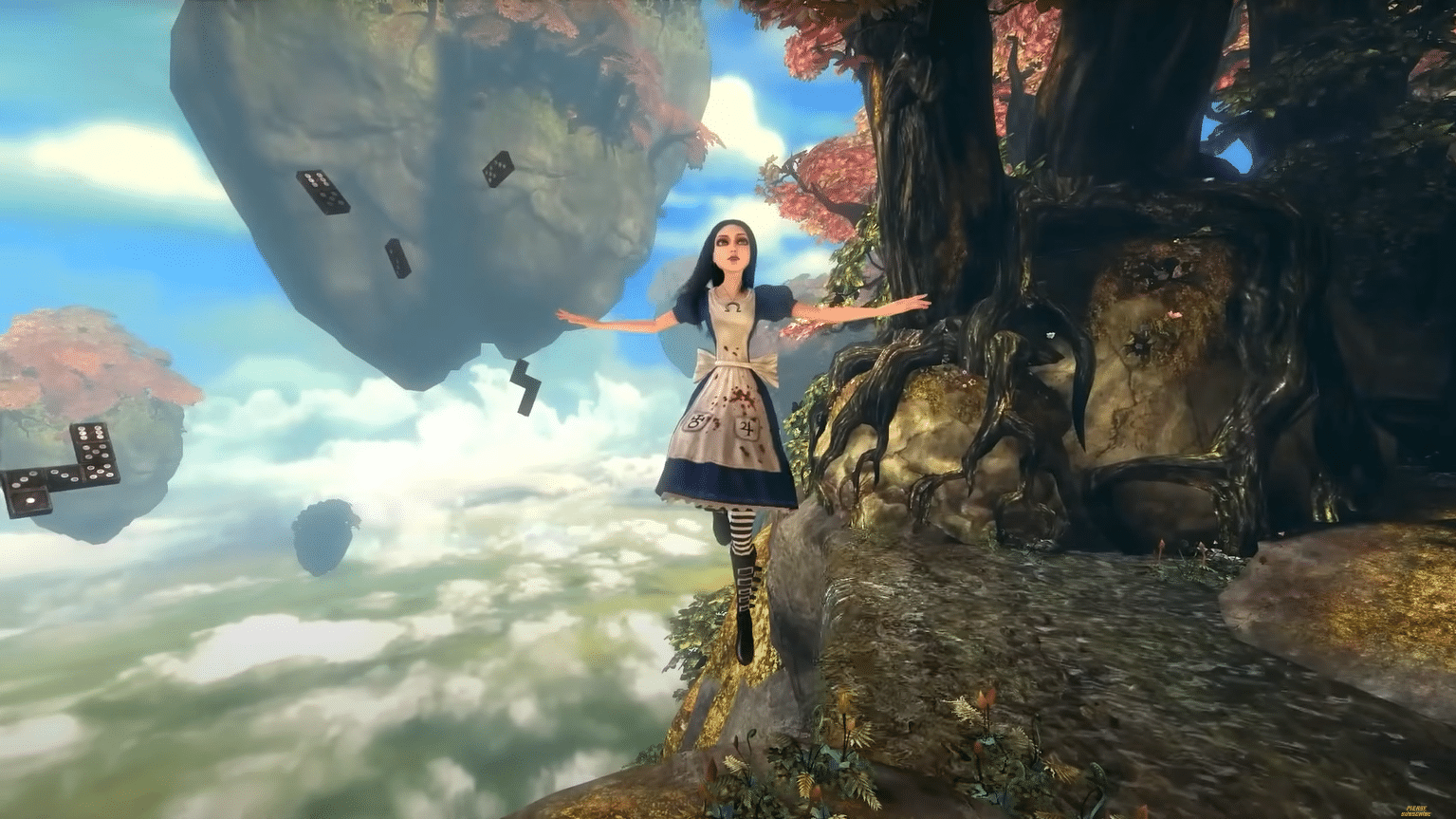
Alice: Madness Returns, on the other hand, suffers from the almost exact opposite problem: it’s too easy. I actually had to bump up the difficulty to hard to feel like I was getting any kind of challenge from the combat. Enemies had very visible “tells” you could notice in battle, and the weapons you acquire can easily be leveled up and made overpowered, defeating basic enemies with a single hit sometimes. The combat itself was also significantly improved, with the weapons each feeling distinct and having their advantages, making the fights themselves more strategic. Additionally, Alice controls much better now, with her movement actually having some weight to it, and the triple-jump made traversing the levels much more enjoyable.
This game is gorgeous and bursting with creativity in its design. Wonderland is back and weirder than ever, and your journey takes you to some very interesting places. Hatter’s Domain, the Oriental Grove, and the Infernal Train are all wonderfully imaginative and fun to explore, while the Dollhouse is disturbing to an entirely new level. Alice also unlocks a unique dress in each level. My particular favorite was the Siren Dress, unlocked in the Deluded Depths, replete with bioluminescent frills and an anglerfish skeleton instead of a bow.

Madness Returns follows Alice after the events at the asylum, where she lives and works at an orphanage under the counsel of a psychiatrist, aiming to help her forget her traumatic past. The story is told as she shifts between reality and Wonderland, trying to unlock the truth of her family’s death. Throughout the course of the game, she recovers these memories and those of significant people in her life. These memories are just one of the many collectibles hidden throughout the game for players to find, along with bottles, pig snouts, and Radula Room challenge levels. These collectible items add something that American McGee’s Alice is missing, which is that explorative element. In the first game, the levels can be difficult to navigate, and there’s no reward for scouring every corner. But Madness Returns has all of the aforementioned collectibles, making maneuvering through the levels much more fun.
I had an inverse experience with these games. The first one, while unquestionably difficulty, was extremely rewarding to finally conquer, while the sequel was much easier to get through and not as satisfying to overcome. Instead of being disincentivized to explore levels in the first game, the second makes searching for secrets rewarding. Whereas the original game had lots of bosses, Madness Returns only has one in the final boss. A strangely balanced experience overall, apropos to the strange nature of Wonderland itself. I’d like to see a follow-up someday, but given the games’ endings, I’m not sure where the story could go. I have no doubt McGee can come up with something appropriate, but how far down the rabbit hole will Alice go?
 LAFworks